
The Journal
Saudi Developer Pre-Sales: The Cost of Lead Decay
Saudi developers lose qualified buyers to slow follow-up during high-volume launches. This piece maps where the revenue slips and what AI-augmented pre-sales changes in the first 72 hours.
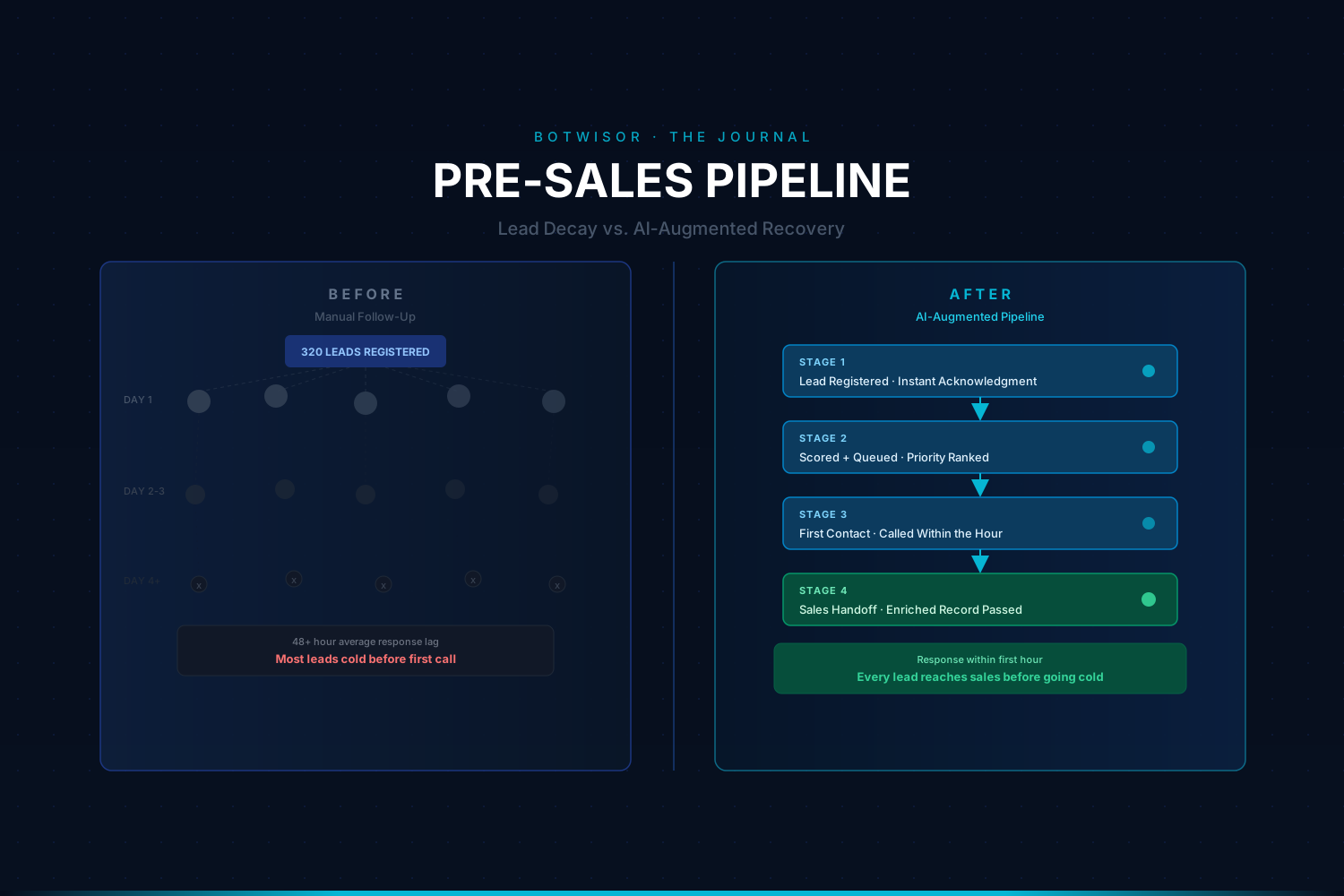
Saudi residential developers managing high-volume launch pipelines lose a measurable share of qualified buyers to slow follow-up and fragmented manual tracking. AI-augmented pre-sales changes the conversion rate without disrupting the relationship-led sales culture that KSA buyers expect. The loss is rarely visible in aggregate numbers; it surfaces only when unit-level revenue analysis reveals who called back first.
What Manual Pre-Sales Looks Like in a Saudi Launch
A well-marketed off-plan launch in Riyadh or Jeddah can generate several hundred interest registrations over a single weekend. The sales team returns Sunday to find a shared spreadsheet of names, a backlog of WhatsApp replies, and a phone queue they cannot clear before the week is half over.
The manual pre-sales workflow tends to follow this pattern:
- Leads collected via a landing page or event registration form, entered into a shared spreadsheet
- Coordinators call through the list in sequence, with no scoring or prioritization
- WhatsApp follow-up handled individually by each sales agent, with no shared visibility
- Status tracked in a column of the spreadsheet: "Called," "No answer," "Interested," "Will call back"
- No automatic re-engagement for leads who did not pick up or respond
- No structured handoff protocol from coordinator to senior sales rep
This approach works when launch volumes are manageable. It fails when a project generates 400 registrations in 72 hours, which is routine for a well-positioned development near NEOM's residential corridors or the Diriyah Gate zones.
The outcome is predictable: the sales team works through the first third of the list carefully, the middle third sporadically, and the final third not at all before the pipeline goes cold.
The Lead Decay Window
Speed-to-response has a well-documented effect on sales conversion. Research across high-value consumer sales consistently shows that contact rates drop steeply within the first hour of registration; by 24 hours, a prospect is significantly less likely to engage than in the first 60 minutes. In Saudi real estate, the dynamic is more acute.
A buyer at the SAR 1M to SAR 5M price point is often registering interest in two or three projects during the same week. They attend a launch event, complete a form, and wait to hear back. The developer who calls first, with a prepared answer to their specific inquiry, controls the conversation. The one who calls on day three frequently hears: "We already made a deposit with another project."
The arithmetic of this decay, worked through at scale, is uncomfortable. Consider a launch with 320 registered leads and an average unit price of SAR 1.6M. If manual follow-up results in meaningful first contact with 55% of leads, and a competing developer with faster response captures 15% of the leads that decayed, those 48 buyers at a 10% close rate represent SAR 7.7M in units that closed elsewhere. That is not a forecast; it is a structural consequence of response time.
Before and After: The AI-Augmented Pipeline
The comparison below is not about replacing salespeople. It is about what happens in the mechanical layer of pre-sales: the first 72 hours between registration and the first substantive human conversation.
| Stage | Manual (Before) | AI-Augmented (After) |
|---|---|---|
| Lead receipt | Spreadsheet row added; no immediate action | Automatic acknowledgment sent within seconds of registration |
| Lead scoring | Coordinator reads each row; prioritizes by instinct | Scored by source, inquiry detail, price signal, and response pattern |
| Follow-up timing | Called when coordinator has capacity, often hours or days later | Call triggered within the first hour; re-attempt scheduled on no answer |
| CRM record quality | Name, phone number, project name | Enriched record: unit type preference, budget signal, preferred language, source channel |
| No-answer recovery | Marked "tried, no answer" and deprioritized | Automated 5-day re-engagement cadence across alternate channels |
| Sales rep handoff | Verbal or message-based; frequently missing context | Structured handoff with full interaction history and lead score |
| Pipeline visibility | Manager asks for updates verbally | Real-time dashboard: hot leads, stalled leads, conversion velocity |
The automated layer operates in the first 72 hours. Every conversation from first substantive contact onward stays with the sales team.
Why a CRM Alone Does Not Solve This
Many developers have already purchased a CRM. The system is installed, an administrator configured it, and the sales team uses it inconsistently. This is a common starting point.
A CRM without connected automation does not fix the response-time problem. It shifts the manual work one step later in the process. Coordinators still open the CRM, enter data by hand, schedule calls themselves, and depend on their own memory for follow-up. The lead decay window remains intact.
What changes the outcome is not the software itself but the connections built around it: the lead form that populates the CRM automatically at the moment of registration, the logic that scores and queues leads before any human touches them, the rule that triggers a WhatsApp acknowledgment within 60 seconds, and the re-engagement sequence that activates when contact is not made. These connections are where the gap closes and where revenue is recovered or lost.
Why Vision 2030 Makes This Gap Harder to Ignore
Saudi Arabia's residential development market is running at a pace that manual pre-sales processes were not designed to handle.
The concentration of mega-project launches, from NEOM residential parcels to The Valley phases, Diriyah Gate offerings, and Red Sea resort properties, has created a buyer pool that is broader, faster-moving, and more competitive than the pre-2020 market. Foreign investor programs under Vision 2030, including the relaxation of ownership restrictions in designated zones, have added international buyers accustomed to digital-first response speeds.
For a developer managing two or three simultaneous launches across Riyadh, the Eastern Province, and a giga-project zone, the coordination load of manual follow-up scales badly. A sales team that managed 200 leads per launch cannot manage 600 across three projects with the same spreadsheet and the same coordination headcount.
Developers capturing more of the available demand are those who have automated the mechanical layer of their pipeline while preserving the relationship-led closing process that Saudi buyers expect.
What Stays Human in the Pipeline
Pre-sales automation does not flatten the sales relationship. Saudi buyers at the SAR 1M+ price point expect to speak with a senior sales advisor, visit the showroom or model villa, review the master plan, and build a degree of trust before committing a deposit. That dynamic is not changing.
What the automated layer handles: the first 72 hours of lead management, when response speed and consistency determine whether a lead stays warm or goes cold. What the sales team handles: every substantive conversation from the first call forward, the site visit, the negotiation, and the close.
A developer considering this kind of system is not replacing their team. They are ensuring that warm leads reach the team's hands before they cool, and that each handoff carries enough context to start the conversation properly.
Book a Free Automation Audit
If your sales team is working from a spreadsheet the week after a launch, the gap is almost certainly larger than the numbers currently reflect. Book a free automation audit and we will walk through your pre-sales pipeline stage by stage, identify where leads are decaying and why, and show exactly what a connected system would recover. No cost, no commitment.