
The Journal
The Delivery Exception Queue Saudi Retailers Clear by Hand
A failed delivery creates a coordinator task at most Saudi e-commerce operations. Here is what the manual queue costs and what automated resolution changes.
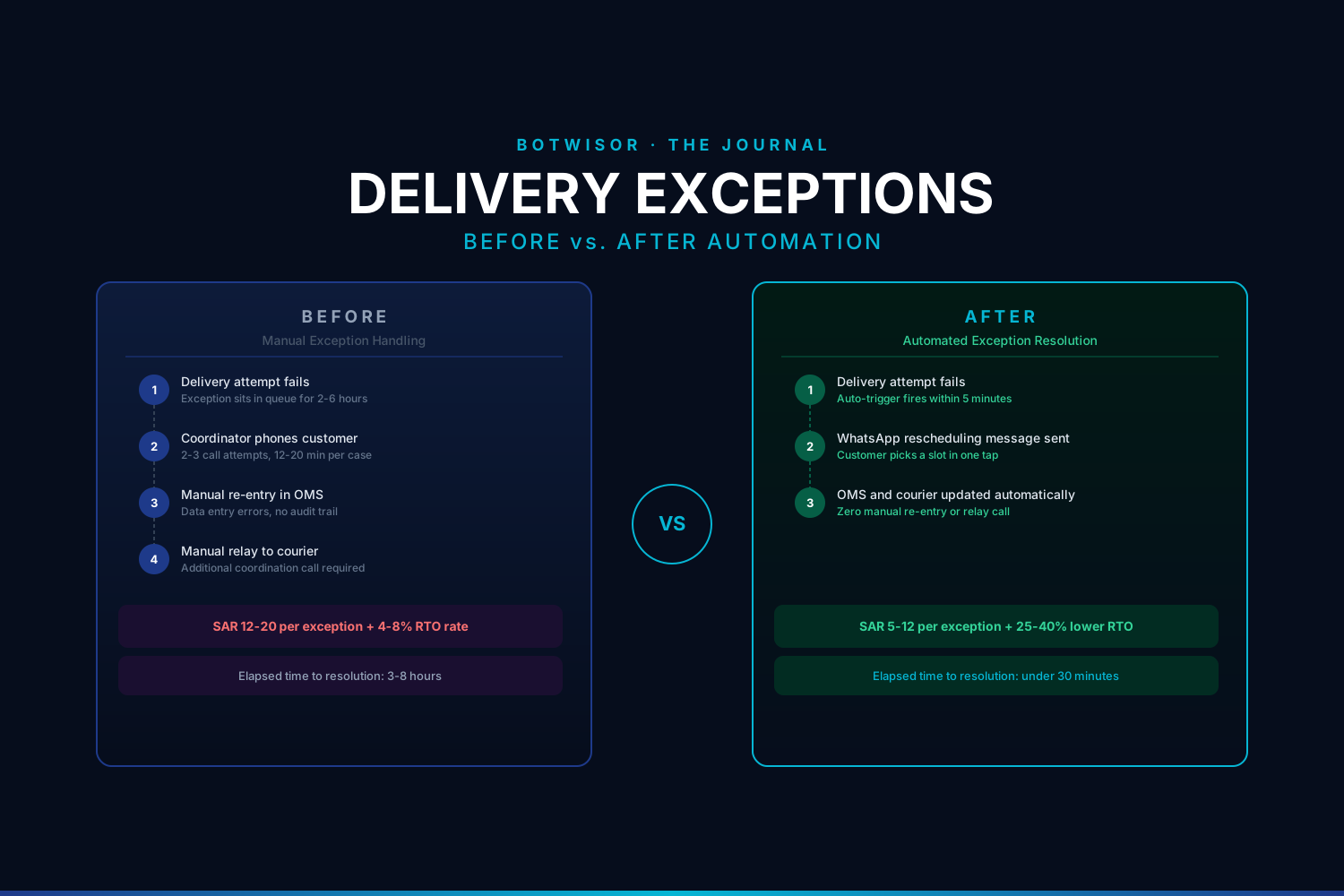
Saudi e-commerce brands fail between 8 and 15 percent of first delivery attempts, and most handle those exceptions through a manual coordinator queue. A team member calls the customer, agrees a new slot, updates the OMS by hand, and relays the change to the courier. At scale, this becomes one of the most expensive and least measured cost centres in last-mile operations.
At 100 daily orders the manual process is manageable. At 500 or 1,000 orders it absorbs coordinator time, inflates re-run courier costs, and elevates return-to-origin rates in ways that rarely appear on any dashboard.
What Is a Delivery Exception in Saudi E-Commerce?
A delivery exception is any failed first delivery attempt: customer unreachable, address unverifiable, customer requests a different time window, COD payment not available at the door, or the consignee refuses the order. In Saudi Arabia, three structural factors push exception rates above the global e-commerce average.
Address precision. Physical addressing standards are still maturing across many Saudi cities. Delivery riders navigate by landmark and phone guidance, and a single unanswered call can mean a failed attempt and a return journey.
COD cash dependency. Saudi e-commerce still carries a higher cash-on-delivery share than comparable markets. When a delivery fails under COD, the order stays live, revenue stays uncollected, and the merchant absorbs the cost of the second attempt.
Evening delivery concentration. Saudi consumers are predominantly home in evening hours, which compresses the window when deliveries succeed and raises daytime exception rates at operations running standard morning routes.
None of these factors shrink as order volume grows.
How the Manual Exception Queue Works
The standard operating sequence at most Saudi e-commerce brands handling exceptions manually runs as follows:
- The courier marks the order as "attempted" in the delivery management system.
- A customer service coordinator receives the exception flag, often several hours after the failed attempt.
- The coordinator calls the customer to agree a new delivery window.
- The updated slot is manually entered into the OMS or WMS.
- The new window is relayed to the 3PL or owned fleet for re-slotting.
- If no contact is made after two call attempts, the order is escalated, held, or returned to origin.
Each resolved exception consumes between 12 and 20 minutes of coordinator time, spread across multiple steps and an extended elapsed window between first failure and confirmed re-delivery.
What the Queue Actually Costs
The direct cost of manual exception handling has two components: coordinator time per exception and the downstream cost of exceptions that cannot be resolved.
| Cost Item | Manual Model | Illustrative Range |
|---|---|---|
| Coordinator time per exception | 12-20 minutes | SAR 7-12 per exception (on coordinator salary basis) |
| Second-attempt courier run | Additional route slot | SAR 18-30 per re-run |
| Return-to-origin (unresolvable) | 4-8% of total orders | SAR 35-55 per RTO (reverse logistics and restocking) |
| Elapsed time to resolution | 3-8 hours | Customer experience degraded, repeat-purchase risk elevated |
For an operation processing 800 orders per day at a 10 percent exception rate, the daily exception volume is 80 cases. At a conservative SAR 30 per resolved exception including re-route costs, the monthly bill for manual exception coordination runs to approximately SAR 72,000 before accounting for unresolvable returns.
The RTO component compounds the problem. Every order returned to the warehouse generates reverse logistics cost, a quality inspection cycle, and a refund or credit obligation. For fashion and consumer electronics, two of Saudi Arabia's fastest-growing e-commerce categories, sustained RTO rates above five percent begin to structurally erode unit economics.
Before and After: Manual Exception Handling vs. Automated Resolution
| Stage | Manual Model | Automated Model |
|---|---|---|
| Time from failure to first customer contact | 2-6 hours (queue wait) | Under 5 minutes (auto-trigger) |
| Customer contact method | Coordinator phone call | WhatsApp rescheduling message |
| Slot selection | Verbal agreement, manual re-entry | Customer taps one option; OMS updates automatically |
| Courier notification | Manual relay call | Real-time re-slot confirmation |
| Coordinator time per resolved exception | 12-20 minutes | Under 2 minutes (escalations only) |
| Second-attempt success rate | Baseline | Typically 15-25% higher |
| RTO rate impact | Baseline | 25-40% reduction within two quarters |
The structural difference is timing. Manual resolution contacts the customer hours after the failed attempt, when they have moved on and are less likely to re-engage. Automated messaging reaches them within minutes, while the missed delivery is still top of mind. That timing difference accounts for most of the improvement in second-attempt success rates.
What Does Not Change
Automation addresses the coordination layer, not the physical delivery. The courier still executes the second attempt. The warehouse still processes genuine returns. The quality team still inspects and restocks RTO units. The 3PL contract terms, delivery zone agreements, and courier SLAs remain unchanged.
What changes is who orchestrates the rescheduling and how long it takes. The coordinator team shifts from processing every exception individually to handling only the cases automated resolution cannot close: customers who do not respond within 24 hours, address verification failures, and fraud escalations.
The Scale Problem Saudi E-Commerce Operators Face
Saudi Arabia's Vision 2030 economic targets project the domestic e-commerce market reaching SAR 120 billion in the near term. Brands building toward that scale on a manual exception model will hit a staffing ceiling before they hit a delivery ceiling.
Exception volume scales linearly with order volume. Coordinator headcount to absorb that volume at the current model scales roughly linearly too. An operation processing 2,000 daily orders at a 10 percent exception rate faces 200 exception resolutions every day. At 15 minutes each, that is 50 coordinator hours: six to seven full-time equivalents dedicated solely to delivery exception calls, before any other customer service workload.
At 5,000 daily orders the arithmetic does not hold without automation. Operators who solve their exception handling before scaling avoid this ceiling. Those who do not find that CX headcount growth outpaces the margin benefit of higher order volume.
Where to Begin
The most useful first step is a measurement exercise rather than a technology decision. Pull three months of delivery data from your OMS or 3PL reporting portal and calculate four figures:
- First-attempt success rate, by city and delivery zone
- Average elapsed time from first failed attempt to confirmed re-slot
- RTO rate, by SKU category and delivery zone
- Coordinator hours attributed to exception-handling calls per week
These four figures will show where in the exception lifecycle your ops cost is concentrated. Most Saudi e-commerce operations that run this exercise find that 60 to 70 percent of coordinator exception-handling time sits in the initial customer contact step, which is precisely what automated messaging addresses.
If those figures are not available from your current reporting setup, that is itself a finding: you are carrying a cost centre you cannot measure, which means you cannot manage it.
→ Request a free delivery exception audit — we map your current exception rate, estimate the monthly ops cost, and identify where an automated resolution layer reduces your RTO rate and coordinator load.