
The Journal
What Saudi Corporate Banks Lose to the Credit Renewal Queue
Saudi bank credit facility renewals take 6-12 weeks manually. The queue costs RM time, client trust, and the upsell window that renewal was designed to open.
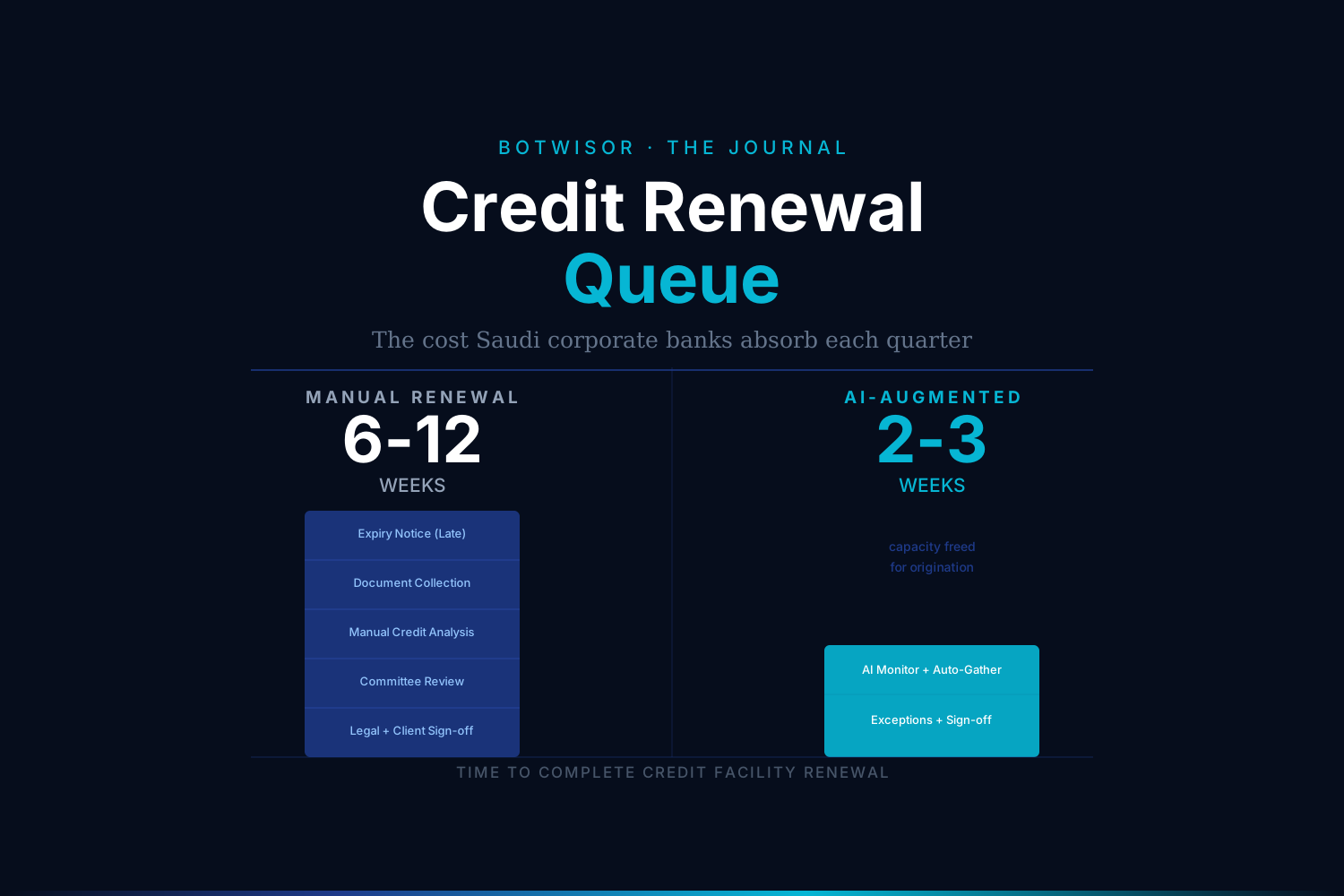
When a corporate credit facility renewal sits in a queue for six to twelve weeks, the bank is not just processing paperwork. It is handing a competitor a window. Saudi corporate clients whose facilities are delayed in renewal, or renewed without a strategic conversation, are the most likely to quietly test alternatives down the road.
What Is the Credit Renewal Queue?
Every Saudi corporate bank — whether one of the Kingdom's major SAMA-regulated institutions or a regional bank with Riyadh or Jeddah operations — manages portfolios of revolving credit lines, overdraft facilities, term loan facilities, and letters of credit for its corporate clients. SAMA's Prudential Standards require formal credit reviews at least annually for all facilities above defined thresholds.
In practice, the renewal process looks like this: an RM (relationship manager) notices, or is reminded by a spreadsheet, that a client's facility expires within the next quarter. The RM then begins gathering updated financial statements, audited accounts, compliance documentation, and collateral valuations. This material goes to a credit analyst, then to a credit committee, then to the legal team for documentation, and back to the client for signatures.
When the process works well, it takes six to eight weeks. When it does not — when documents are incomplete, when the credit committee has a backlog, when legal is occupied with larger transactions — it stretches to twelve weeks or more.
The queue is not a failure mode. It is the default.
Before Automation: How the Queue Builds
Consider a mid-size Saudi corporate bank managing 400 active credit relationships. If each relationship requires one formal renewal per year, that is roughly 33 renewals per month, every month, in addition to new origination, client meetings, and compliance reporting. A team of 15 RMs is managing a continuous, document-heavy workflow that never pauses.
Several structural factors amplify the backlog:
Renewals cluster by fiscal calendar. Many Saudi corporate clients sign credit agreements in Q1, after their fiscal-year financials become available. This creates a renewal surge between March and June each year — precisely when RMs are also managing year-end client reviews and new-business conversations.
Financial statements arrive late. Saudi corporate clients are often privately held, with audited accounts prepared in January and February. By the time documents are submitted and the credit file is updated, the facility may be one to three months from expiry, leaving little processing margin.
Credit risk assessments run manually. Each renewal requires an analyst to read the updated financials, run the bank's risk models (typically in spreadsheets), compare current collateral values against outstanding exposure, and write a credit memo. For a portfolio of 400 relationships, this is a significant recurring analytical burden with no seasonal relief.
Upsell conversations get crowded out. The renewal meeting, the moment when a client is most engaged with their bank, becomes a document-signing session rather than a relationship conversation. The RM is focused on closing the renewal file, not on whether the client's working capital needs have grown since the last facility was structured or whether a new product line warrants a facility increase.
The cost of inaction here is not purely operational. A client who waits ten weeks for a facility renewal, with no proactive communication during that period, and then receives the same facility at the same terms as before, has every reason to benchmark what another institution would offer.
Before vs. After: The Credit Renewal Workflow
| Dimension | Manual Renewal | AI-Augmented Renewal |
|---|---|---|
| Renewal trigger | RM checks spreadsheet (or misses expiry) | AI monitors expiry calendar, triggers workflow 90 days ahead |
| Document gathering | RM emails client, chases for weeks | Integrated data feeds auto-pull updated financials and compliance docs |
| Credit risk refresh | Analyst builds Excel model, writes full memo | AI runs preliminary credit score refresh; analyst reviews exceptions only |
| Credit committee time | Full committee reviews every renewal | Committee reviews materially changed relationships only |
| Turnaround time | 6-12 weeks | 2-3 weeks for standard relationships |
| RM hours per renewal | 8-12 hours | 2-3 hours (review and sign-off only) |
| Upsell capture | Rare — renewal meeting is document-focused | Structured: RM enters meeting with AI-prepared upsell briefing |
| Lapsed facility risk | Occasional — creates credit and compliance risk | Near-zero — automated escalation before any expiry breach |
The Hidden Costs Saudi Banks Are Not Counting
The direct cost of manual credit renewals is RM time. At a fully loaded cost of SAR 75,000 to SAR 120,000 per month for a senior RM, twelve hours per renewal across 400 relationships represents a significant annual drain on capacity that could be directed toward origination and client development instead.
The indirect costs are larger and harder to attribute:
Lapsed facility risk. A corporate facility that expires before renewal documentation is complete creates a technical default position. Even when resolved quickly, it triggers additional compliance paperwork under SAMA credit monitoring requirements and surfaces in credit bureau records. For large facilities, the reputational and regulatory consequences are real.
Invisible churn. Saudi corporate clients rarely announce that they are shopping competitors. They accept a renewal, reduce their usage of the facility over the following quarters, move incremental business to another bank, and eventually shift their primary relationship without voicing dissatisfaction at any point. Banks operating on manual renewal processes have no early signal for this pattern. Banks with AI-augmented workflows can detect declining facility utilization and trigger a relationship intervention weeks before the client is effectively gone.
Missed rate environment windows. When the Saudi Interbank Offered Rate moves, corporate clients renegotiate faster than a manual-process bank can proactively reach them. The bank is always reacting to inbound requests rather than leading the conversation with clients whose exposure warrants a proactive rate discussion.
Compliance escalation cost. Under SAMA's framework for classified credit, late or missed annual reviews on facilities with material exposure changes can trigger supervisory reporting requirements. The administrative cost of managing an escalation is multiples of the cost of keeping renewals current.
Why This Connects to Vision 2030 Financial Sector Goals
SAMA's Financial Sector Development Program — one of the thirteen Vision 2030 realization programs — targets a meaningfully higher ratio of private-sector credit as a share of GDP. Achieving that target means Saudi banks need to process more credit relationships, with more speed and precision, than manual operations currently allow.
A manual renewal queue is not a marginal inefficiency in this context. It is a structural ceiling on how many corporate relationships a bank can manage well per RM. If each facility renewal requires 12 RM hours, the bank's ability to grow its corporate portfolio is directly constrained by analyst and RM headcount — not by credit appetite or capital.
AI-augmented renewal workflows decouple portfolio size from headcount. A team of 15 RMs managing 400 relationships on a manual system is already running at capacity. The same team, with AI handling document orchestration and preliminary risk refresh, can manage 600 to 700 relationships at the same or higher service quality. That difference compounds across a full credit book and across the banking sector as a whole.
Where Saudi Banks Typically Start
Most banks that have addressed this problem begin with the monitoring layer: an automated calendar that flags expiring facilities 90, 60, and 30 days ahead, with owner assignment and escalation rules built in. This step alone reduces lapsed facilities to near-zero and transforms the renewal queue from a reactive pile-up into a structured pipeline.
The next layer is document orchestration: connecting the renewal workflow to client data sources so that the RM's role shifts from chasing documents to reviewing a pre-populated credit file. This reduces per-renewal RM hours substantially and, more importantly, removes the document-chasing period that stretches timelines the most.
The final layer — AI-assisted credit risk refresh and client briefing for upsell — requires deeper integration with core banking systems but delivers the most visible business return: faster credit committee cycles, and RMs who walk into renewal meetings prepared to open a commercial conversation rather than close a paperwork cycle.
No step requires rebuilding the bank's core system. Each layer connects to what is already in place.
The corporate credit renewal queue is one of the most predictable, measurable, and fixable drains on Saudi bank performance. It recurs on a known schedule, it affects every relationship manager, and it surfaces precisely in the moments when corporate clients are most engaged with their bank.
The question is not whether to address it. It is how much it has already cost.
Request a free automation audit to see where your credit renewal workflow is losing time, and what a structured fix would look like for your team.