
The Journal
Saudi Banks Take Three Weeks to Open a Corporate Account
Opening a corporate account in Saudi Arabia takes 10 to 20 business days at most mid-size banks. Clients experience it as repeated document requests and branch visits. The bank experiences it as a staffing cost it has learned to accept.
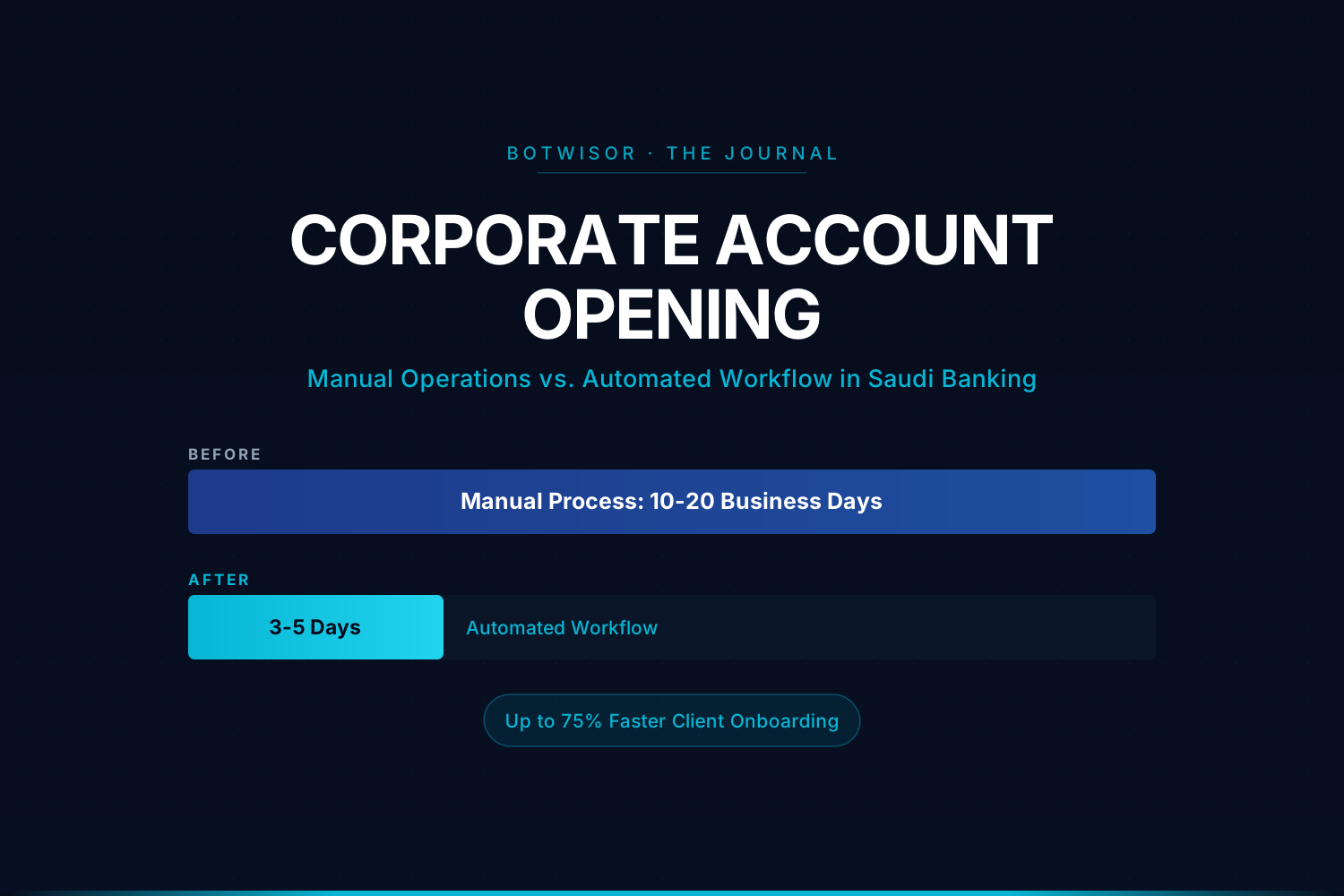
Opening a corporate bank account in Saudi Arabia takes between 10 and 20 business days at most mid-size banks. The client experiences it as a series of document requests, branch visits, and waiting periods with no clear end date. The bank experiences it as a staffing problem it has learned to absorb. Neither experience is improving as long as the process runs on paper, email, and manual data entry.
How a Saudi Bank Typically Opens a Corporate Account
The formal requirements for a corporate current account are consistent across SAMA-regulated institutions: a valid Commercial Registration certificate, the company's Articles of Association, a board resolution authorizing the account and naming signatories, copies of the authorized signatories' national IDs or iqamas, an Ultimate Beneficial Owner declaration, and VAT registration confirmation. For accounts linked to a credit facility, audited financial statements join the list.
Collecting these documents is step one. The problem is how collection happens.
In most mid-size Saudi banks, the relationship manager drives document collection through WhatsApp messages, phone calls, and occasional branch visits. Each round-trip takes one to three business days depending on the client's responsiveness and the completeness of what they submit. When a document is expired, unsigned, or missing an authorized signatory, the cycle restarts.
Once documents are assembled, an operations team member manually enters the client's details into the core banking platform: company name, CR number, Articles of Association dates, signatory records, account type, branch allocation. This is data that already exists in the submitted documents but must be typed again by a human because the core banking system cannot read a scanned PDF.
The completed application then moves to compliance. AML and sanctions screening, required under SAMA's Anti-Money Laundering framework, runs against the company, its directors, and its beneficial owners. At most banks, this is a queue-based process: a compliance officer retrieves the file, runs name checks against watchlists, reviews the results, and either clears the file or flags it for escalation. Queue depth at period-end or around public holidays can push waiting time to five to seven business days.
After compliance clearance, the account manager configures the account parameters in the core system, generates the IBAN, and notifies the relationship manager, who notifies the client. The client may then be asked to return to a branch to sign the account agreement and collect physical tokens or instructions.
Total elapsed time at a typical Saudi mid-size bank: 10 to 20 business days.
Where the Process Stalls
Document re-requests are the primary delay driver. When a document is submitted as a photo taken in poor lighting, when an Articles of Association is an older version that does not reflect a recent ownership change, or when a signatory's iqama has expired by one month, the operations team sends it back. There is no automated check at submission; the first human who opens the file is the first quality gate.
Data entry errors compound the delay. A transposed digit in a CR number or a mismatched company name triggers a SAMA validation failure when the bank attempts to register the account. Correcting it requires the operations team to re-enter the record, re-validate, and re-submit, adding one to three days per correction cycle.
Compliance queues are the least predictable bottleneck. AML screening at most Saudi banks is not a same-day function; it is a batch process reviewed by a team managing multiple obligations simultaneously. When a screening match requires enhanced due diligence, the file can sit for a week or more while the compliance officer assembles supporting information and escalates for sign-off.
Before and After: Manual Onboarding vs. Structured Automation
| Dimension | Manual Process | Automated Workflow |
|---|---|---|
| Document collection | WhatsApp and email; no completeness check at submission | Digital portal with required-field validation and instant client feedback |
| Data entry | Manual transcription into core banking system | OCR extraction from uploaded documents; operator reviews, not re-types |
| AML screening | Queue-based; 3-7 days depending on team load | Automated screening on submission; exceptions routed immediately to compliance |
| Error detection | First human reviewer discovers error; catch-and-return cycle | Field-level validation at upload; errors surfaced before processing begins |
| Timeline | 10-20 business days | 3-5 business days for standard accounts |
| Client touchpoints | Multiple branch visits and document re-submissions | One digital submission session; branch visit only for agreement signing |
| Headcount model | RM, branch ops, compliance, IT; no single handoff point | Automated routing; staff handles exceptions, not volume |
The Client Decides Before the Account Opens
Corporate clients choosing a banking relationship in Saudi Arabia are not making a single-institution commitment. They carry accounts at two or three banks, routing payroll, receivables, and trade finance to different providers based on service quality and responsiveness. A new corporate client comparing two banks, one of which confirms account setup in five days and one that takes three weeks, is already forming a preference during onboarding.
This is not theoretical. Saudi corporate banking has become more competitive. Licensed digital banks, including institutions backed by major Saudi corporates, now operate under SAMA frameworks that allow fully digital account opening for qualifying businesses. International correspondent banks serving Saudi companies with cross-border needs offer streamlined onboarding for relationship expansions. A traditional bank that cannot match the timeline of a structurally faster competitor will win clients on relationship and product alone and will lose some before the account ever opens.
The revenue at stake is not trivial. A Saudi mid-size corporate client maintaining an operating account with an average balance of SAR 2-5 million generates fee income, float revenue, and cross-sell potential that can reach SAR 200,000-600,000 annually across a full banking relationship. An account that never opens because the client moved on is an invisible line in the loss column: there is no rejected application to track, only a prospect who stopped responding.
The Vision 2030 Connection
SAMA's Financial Sector Development Program identifies digital banking infrastructure as a core enabler of economic diversification. The program's objectives include increasing the efficiency of banking operations, reducing the time and cost of financial services delivery, and expanding access to banking for Saudi businesses, including the small and mid-size enterprises that Vision 2030 programs actively support.
Corporate account opening is a direct measure of how well a bank meets these objectives. When the process still depends on a relationship manager collecting PDFs over WhatsApp and a compliance officer running manual watchlist checks, the gap between the bank's stated digital ambition and its operational reality is plainly visible to the clients it is trying to serve.
What Changes When the Process Is Automated
Automation in corporate account opening does not replace the relationship manager. The RM's role in winning the client, understanding the business, and managing the relationship is unchanged. What changes is the operational layer behind that relationship.
When a structured digital intake process replaces document collection, the quality gate moves to the front: clients know on submission whether their documents meet requirements. The operations team receives a complete, validated package rather than a provisional file requiring follow-up. OCR extraction maps submitted documents to core banking fields, which the operator reviews for accuracy rather than transcribing from scratch. AML screening triggers on submission and completes in minutes for clean profiles, with human review reserved for genuine exception cases.
The timeline effect is consistent: banks that have automated corporate onboarding workflows report account setup times falling from three to four weeks to three to five business days. Staff headcount in the onboarding function stays roughly flat; the redeployment is from volume processing to exception management, which is higher-skill, higher-value work.
The compliance improvement is less visible but equally important. An automated process produces a consistent audit trail: every document submitted, every screening result, every approval and override is logged with a timestamp and an actor. When SAMA or internal audit requests the onboarding file for a specific client, it is retrievable in minutes rather than assembled from email threads and shared folders.
If your corporate account opening workflow still moves at the pace of document collection and compliance queues, the gap between that timeline and what structured automation delivers is worth measuring before your next new client decides. BotWisor offers a free automation audit for Saudi financial institutions: we map your current onboarding workflow, identify the primary delay drivers, and show what a practical automation path looks like before you commit to anything.