
The Journal
Contractor Payment Certificates: What the Manual Queue Costs Saudi Developers
Contractor payment certificates in Saudi construction sit in manual review queues for 10 to 14 business days. Contractors price that delay into every project bid.
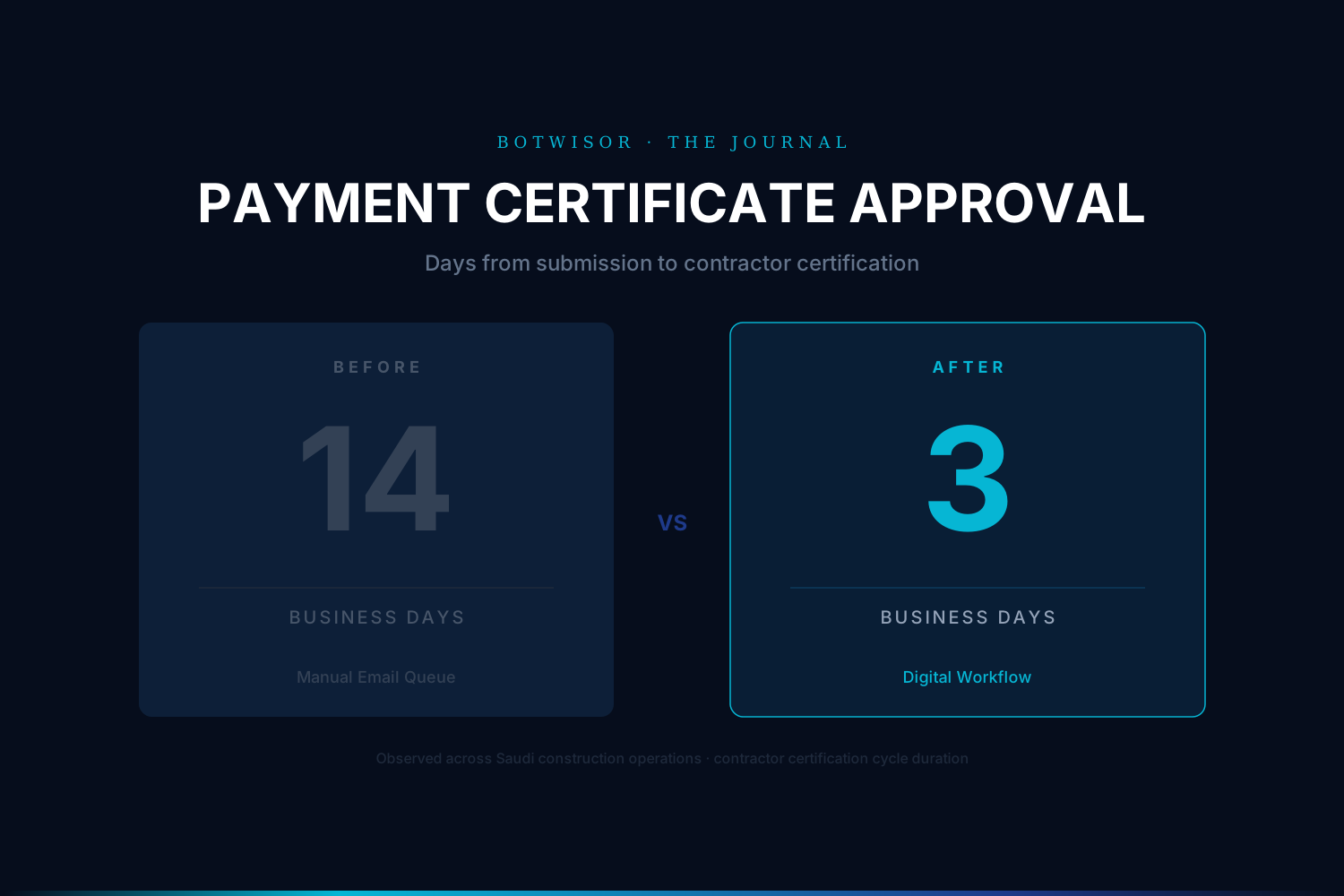
When a contractor submits a payment certificate for completed work on a Saudi construction project, the document joins a manual chain of sign-offs. Engineers, commercial managers, and finance directors each review and forward it through email. Average cycle: 10 to 14 business days. Contractors price that delay into their rates. The developer pays it on every project.
What Is a Contractor Payment Certificate?
In Saudi construction, an Interim Payment Certificate (IPC) is the formal mechanism through which a contractor claims payment for work completed in a defined period, typically monthly. The contractor submits a valuation supported by site measurement records. The developer's project team reviews quantities and rates, agrees the certified amount, and issues the certificate. Payment is then due within the window specified in the contract, commonly 28 to 42 days from certification.
The critical point is where that payment window begins. It starts from certification, not from submission. When the certification process itself consumes 12 business days, those 12 days are lost before the contractual payment clock even begins to run.
How the Manual Approval Queue Builds
A contractor payment certificate in a typical Saudi developer organization moves through roughly four stages before it is certified:
- Site engineer review. The contractor's quantities and progress claims are verified against site records and inspection reports. This takes 2 to 4 days when site documentation is current and the engineer is available.
- Commercial or quantity surveyor review. Rates are confirmed against the bill of quantities, variations are flagged, and disputed items are noted for resolution. Another 2 to 3 days.
- Finance review. The finance team confirms budget allocation, checks the payment against the project cash flow forecast, and verifies VAT treatment for each line item. 1 to 2 days.
- Authorization. The project director, CFO, or designated signatory signs off on the certificate before it is released to the contractor. 1 to 3 days.
Across a project running 10 to 15 active contractor packages simultaneously, these queues overlap and compete. A quantity surveyor reviewing three certificates at the same time works more slowly than one reviewing a single document. A certificate that returns for a missing attachment restarts from the beginning of its queue stage. The baseline cycle of 10 to 14 business days has outliers in the 18 to 22 day range when key reviewers are traveling, when projects are at peak construction, or when a dispute on one certificate holds up the review of others.
What Contractors Do With That Number
Contractors who have worked with Saudi developers across multiple projects know the payment certification cycle of each client. They apply that knowledge when pricing the next bid.
Risk premiums enter the bill of quantities. A contractor quoting work for a developer known for slow certification builds a buffer into mobilization costs, preliminaries, and sometimes direct unit rates. The typical buffer for slow-paying clients in Saudi construction, as discussed by commercial managers at project briefings in Riyadh and Jeddah, runs 5 to 8% above the rates the same contractor would offer a developer known for prompt certification on comparable scope. This premium does not appear as a line item on the tender. It is distributed invisibly across the BOQ. The developer evaluating tenders has no way to distinguish the payment-risk premium from legitimate market pricing.
On-site deployment matches expected cash flow. A contractor who expects a 45-day effective payment cycle (12 business days for certification, plus 30 days for payment) does not deploy labor and materials at a pace that front-loads cost against a payment stream that will arrive six to seven weeks later. Mobilization is staged conservatively. Critical-path packages that depend on the contractor's cash flow deployment advance more slowly than the program assumes. The timeline slips, not because the contractor is underperforming, but because their deployment pace is calibrated to a payment cycle that the developer's process created.
Manual Queue Versus a Structured Approval Workflow
| Metric | Manual Email Queue | Structured Digital Workflow |
|---|---|---|
| Average certification cycle | 10 to 14 business days | 2 to 4 business days |
| Finance visibility on accrued costs | Monthly, from reconciliation | Real-time, per certificate |
| Contractor pricing behavior | Risk premium embedded in BOQ | Reduced contingency in competitive markets |
| ZATCA VAT input-credit timing | Delayed by certification lag | On-cycle with certification |
| Monthly accruals accuracy | Estimated; revised at month-end | Confirmed committed cost |
| Audit trail per certificate | Scattered across email threads | Timestamped and structured |
| Dispute frequency | Higher (delays compound later claims) | Lower (faster measurement resolution) |
The SAR Cost Layers Developers Cannot See
Contractor pricing premium. On a SAR 40M construction package, a 6% risk premium embedded in BOQ rates represents SAR 2.4M in additional project cost. That premium is invisible at tender evaluation. The developer accepts it as market pricing. Across a portfolio of multiple projects running simultaneously, this is a material, persistent overhead.
Timeline extension carrying costs. When critical-path contractors deploy at reduced mobilization pace because their cash flow is constrained by a 45 to 50 day effective payment cycle, a 12-month program extends. In Saudi construction, each additional month of project extension typically carries holding costs of 0.5 to 1.5% of total project value in financing charges, supervision fees, and site overhead. A SAR 100M project extended by one month incurs SAR 500K to SAR 1.5M in additional holding cost, none of which appears on the IPC register.
Finance accruals gap. When contractor certificates are pending in email queues, the committed cost they represent is absent from the finance team's picture. Monthly project reports and investor dashboards carry estimated accruals rather than confirmed figures. At portfolio level, this understatement of committed cost produces investor reporting that does not reflect actual project exposure until the certificates eventually clear.
VAT recovery deferral. Saudi construction contracts are subject to 15% VAT. Input VAT on certified contractor payments is recoverable through ZATCA's normal quarterly cycle. When certification is delayed 12 business days, the input-credit clock starts later. Across multiple simultaneous projects with dozens of active IPC cycles per quarter, the aggregate financing cost of deferred VAT recovery is non-trivial.
What the Vision 2030 Construction Pipeline Amplifies
Saudi Arabia's construction market has expanded significantly under Vision 2030 mandates. Riyadh's metro-adjacent residential expansion, NEOM's infrastructure packages, the Red Sea Project, and Diriyah Gate have all increased the number of active contractor packages across the kingdom. A developer managing 20 concurrent contractor packages five years ago may now manage 40 or more.
The manual email queue that was slow with 20 packages does not become faster with 40. Certification cycles lengthen under volume. Finance visibility gaps widen. Contractor risk premiums compound across a larger tender book. RERA's Wafi milestones, which require certified construction progress to trigger escrow releases to the developer, mean that a certification backlog delays not only contractor payments but the developer's own access to project cash.
The problem is not new in the Saudi construction market. The scale at which it now operates is.
What a Structured Approval Workflow Changes
When contractor payment certification runs on a defined digital process, the cycle shortens and visibility appears.
Certificates are submitted digitally, routed automatically to each stage, and tracked against defined turnaround targets. A certificate that has been awaiting the QS for three days without action triggers an escalation, not another WhatsApp message to chase. Each stage has a time budget. The project manager can see, at any moment, which certificates are pending, at which stage, and how long they have been there.
Finance sees committed cost at the moment of submission, not when the certificate eventually clears. Accruals become accurate. Month-end close does not require the finance team to reconstruct certificate status from scattered email threads.
Contractors receive certified amounts within a predictable, shortened window. Over time, risk premiums on new packages from established contractors reduce. Timeline deployment improves. The downstream effects on project program and investor reporting both move in the same direction.
A free automation audit from BotWisor covers the contractor payment certification process across your active project portfolio, identifies where certificates are spending the most time in queue, and estimates what that lag is costing in contractor risk premiums and finance reporting gaps. The review is free and takes under an hour.