
The Journal
Saudi Construction Change Orders: When Paper Trails Become Payment Disputes
Unresolved change orders are Saudi construction's most common payment dispute trigger. Here is what informal tracking costs and what structured variation management recovers.
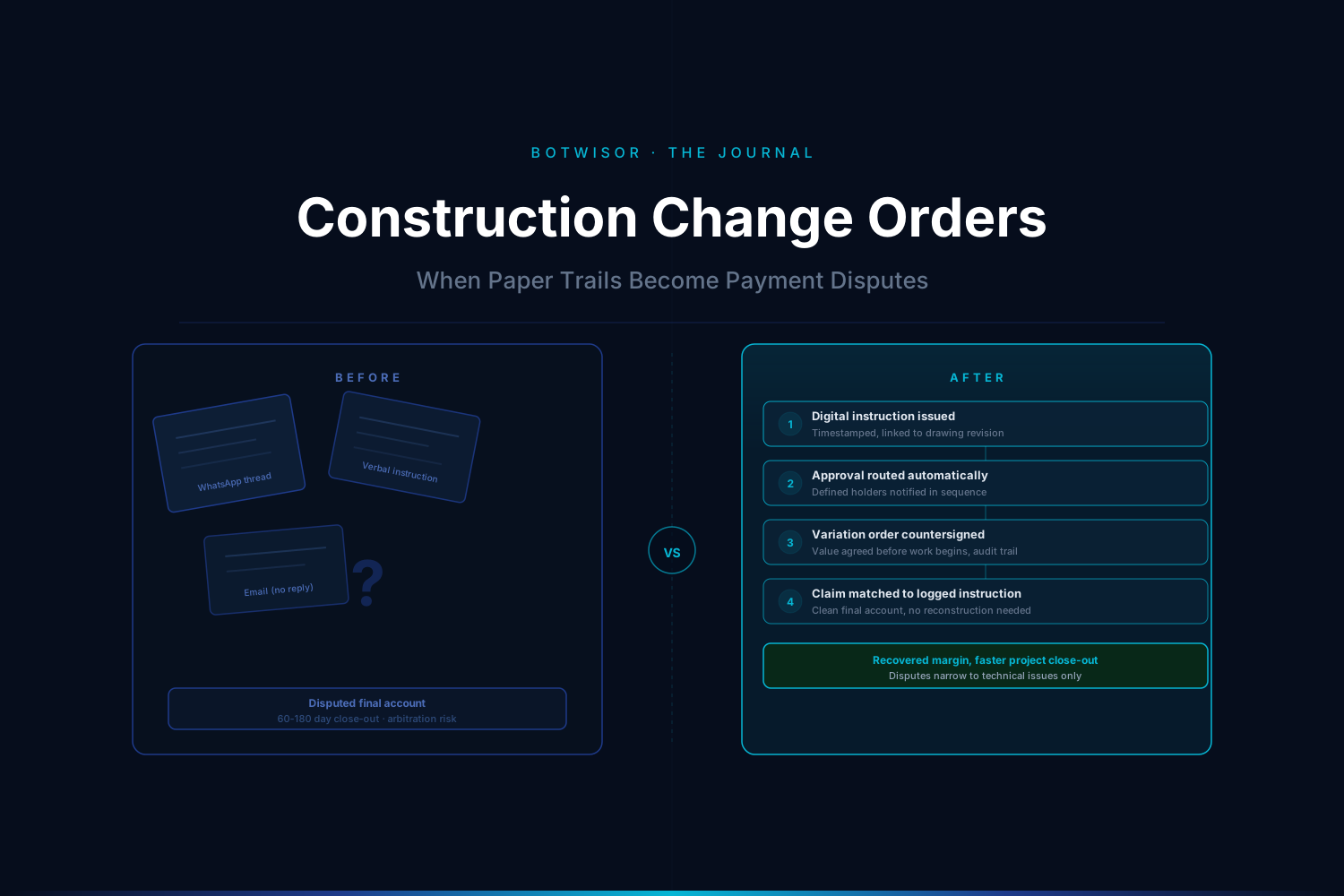
Change orders account for more payment disputes on Saudi construction projects than any other contract mechanism. When variation instructions arrive by WhatsApp and formal records follow months later, the disagreement at project close is rarely about the work itself. It is about what was authorized. That is a documentation problem, and it costs real margin.
What Is a Construction Change Order?
A change order, referred to in most Saudi contracts as a variation order, is a formal amendment to the original construction contract. It modifies scope, timeline, cost, or all three. Change orders arise when the client requests additions to the original design, when site conditions differ from survey data, or when a design consultant revises drawings mid-construction.
Under FIDIC contract terms, which govern the majority of major construction projects in Saudi Arabia, variation orders require written instruction from the engineer of record and a formal claim procedure from the contractor. The procedure exists because change orders involve money. On a SAR 200 million project, variation orders typically represent an additional SAR 15 to 30 million by the time final accounts are settled.
Why Change Orders Are Particularly Sensitive in Saudi Arabia
Saudi Arabia's construction pipeline is growing faster than the administrative infrastructure that manages it. The giga-projects driven by Vision 2030, including NEOM, The Line, the Red Sea development, and Qiddiya, involve compressed design-build timelines, multiple simultaneous work packages, and design revisions driven by evolving client requirements. In this environment, change orders are not occasional. On complex sites, project teams can issue dozens per month.
The challenge is not volume. It is the chain of custody. A design consultant revises a drawing in the evening. The site engineer sees it the next morning and relays the instruction to the foreman by WhatsApp. Work begins. Two months later, the contractor submits a formal variation claim. The developer's project manager has rotated to the next site. The original message thread is buried under hundreds of unrelated exchanges. The engineer recalls the instruction as provisional. The dispute begins.
This is not a rare failure mode. On a significant share of Saudi construction projects, from private residential developments in Riyadh's expanding districts to commercial fit-out in Jeddah and the King Abdullah Economic City, this is the operating default.
How Manual Variation Order Processes Create Disputes
When change orders run on informal communication, the problems accumulate in layers.
Instruction without documentation. Work starts before a formal variation order is issued. This is often deliberate: schedule pressure pushes developers to get moving before paperwork catches up. The contractor obliges, trusting the relationship. The documentation never catches up.
Disputed scope at claim time. By the time the contractor submits a formal claim, the developer's team disagrees on what was authorized. Did the variation cover the foundation modification or only the superstructure amendment? Without a contemporaneous written instruction, the answer depends on memory and archive organization.
Batched claim submissions. Contractors on complex Saudi projects often defer variation claims rather than submit each one as it arises. By the time a batch arrives, months into the project, the team has rotated, the original engineer has moved on, and reconstructing the justification for each item takes weeks.
Payment withheld and legal costs begin. The developer withholds the disputed portion of the final payment. The contractor escalates to the Saudi Center for Commercial Arbitration. Legal fees accumulate on both sides. A SAR 1.5 million variation dispute can consume SAR 200,000 or more in arbitration and legal costs before resolution, in addition to the cash collection delay for both parties.
| Stage | Manual Workflow | Structured Workflow |
|---|---|---|
| Instruction capture | WhatsApp / verbal / email | Digital form, timestamped, linked to drawings |
| Scope definition | Free text, prone to interpretation | Tied to BOQ line items and current drawing revision |
| Approval routing | Manual follow-up, email chains | Automated, defined approvers in sequence |
| Contractor submission | Batch claims, often months late | Submitted against each logged instruction |
| Dispute evidence | Archived messages, memory | Complete audit trail with timestamps |
| Final account close-out | 60 to 180 days after practical completion | Significantly shorter; fewer open items |
What Unresolved Change Orders Actually Cost
The financial impact extends well beyond the disputed amount.
Margin compression at project close. Final account negotiations on Saudi construction projects routinely run three to six months after practical completion. During that period, the developer's working capital is partially encumbered by contingent variation liabilities. On a project carrying SAR 25 million in unresolved variations at close, a 20 percent settlement adjustment represents SAR 5 million erased from the original project return.
Cascading prolongation claims. Variation orders that extend the programme generate secondary claims: contractor prolongation costs, extended site supervision fees, material cost escalation. These downstream claims are substantially harder to contest when the original instruction was not formally documented.
Subcontractor exposure. Saudi developers typically engage a principal contractor who sub-lets significant packages to specialist trades. When variation disputes surface at main contract level, the same disagreements cascade downward. A developer who entered a dispute over one variation claim can find two or three cascading subcontract claims attached to it.
Relationship capital. Saudi construction markets are relationship-intensive. A payment dispute that reaches formal arbitration closes a contractor relationship that took years to build. The cost of retendering, remobilizing, and managing a contractor transition is rarely modeled against the original variation dispute that triggered the breakdown.
What Structured Change Order Management Produces
The shift from informal to structured variation management does not require enterprise software procurement. It requires enforcing a closed-loop process with audit-trail outputs.
The core workflow is: instruction issued through a documented channel, contractor acknowledgement captured, scope defined against the current drawing revision, value agreed before work commences, formal variation order countersigned by both parties, claim tracked to payment against the logged instruction.
When this loop runs consistently, several outcomes follow. Variation claims arrive matched to recorded instructions, so there is no argument about authorization. Approval holders receive sequential notifications, so no variation sits unactioned for weeks. At project close, the final account negotiation starts from a structured register rather than from a contested reconstruction of events. Disputes narrow to genuine technical disagreements rather than administrative failures.
For developers managing multiple active projects simultaneously, each carrying SAR 10 to 30 million in variation exposure at any given stage, the aggregate risk reduction is material.
The Vision 2030 Context
The scale of Saudi Arabia's construction ambition under Vision 2030 means this problem grows without deliberate intervention. Giga-project sites involve multiple prime contractors, hundreds of concurrent work packages, and design evolution driven by client requirements that themselves evolve. Variation order risk is built into the programme structure.
Institutional investors and sovereign clients increasingly require documented variation registers as part of project governance frameworks. Developers funded through SIDF or partnering with government development entities operate under documentation standards that informal messaging-based processes cannot satisfy. The developers who will win repeat mandates on large public-private development programmes are those who demonstrate that their variation management produces clean, auditable records at project close.
What to Do Next
If your project team is managing change orders through message threads and quarterly contractor claim batches, the financial exposure sits in your final account. The time to address it is not during close-out negotiations; it is before the next instruction is issued.
A structured review of your current variation management process, from the point of instruction issuance to final account settlement, typically takes one to two days. The findings identify a recoverable margin gap that pays back the cost of a structured process by a wide margin.
Book a free automation audit with BotWisor to map your change order exposure and identify what a structured variation management process would recover.