
The Journal
Saudi Banks Defer Re-KYC Reviews Until Accounts Freeze
Saudi banks run periodic client KYC reviews manually. When the queue outpaces the team, accounts freeze without warning and real costs follow only after the damage is done.
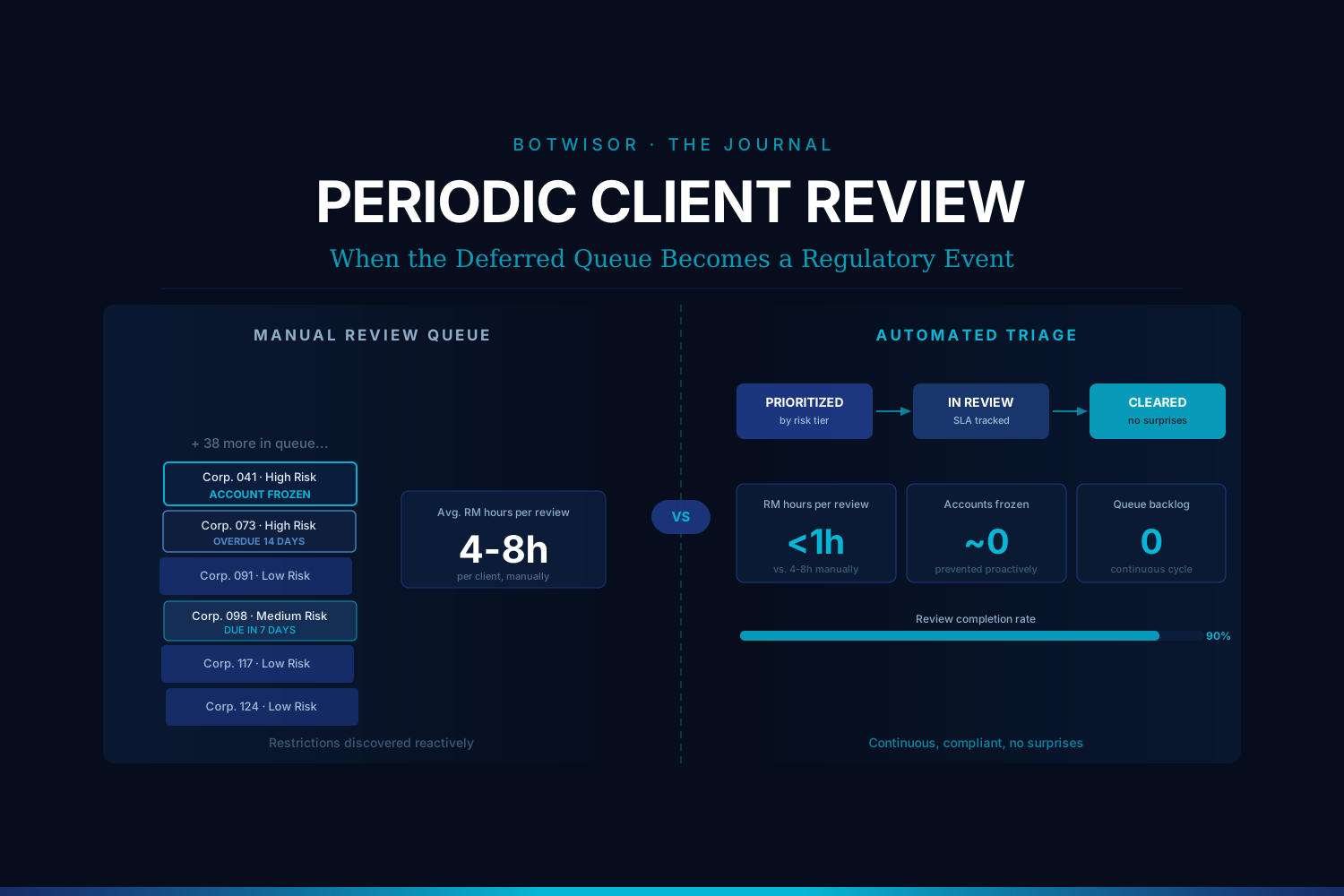
Saudi banks face a compliance obligation that most treat as a back-office queue: the periodic re-verification of every existing client's identity and risk status. Managed manually at most institutions, this cycle accumulates quietly until a system flag fires, an account freezes, and a relationship manager receives a call from a client who cannot complete a payment. By the time the freeze happens, the cost of the backlog has already arrived.
Why Client Re-KYC Is a Continuous Regulatory Obligation
Saudi Arabia's anti-money-laundering framework, governed by SAMA, requires banks to conduct ongoing due diligence on existing customers, not just at account opening. The frequency depends on risk classification. Low-risk clients are typically reviewed every three years. Medium-risk clients, every two. High-risk clients, which include politically exposed persons (PEPs), accounts with significant cross-border flows, and clients flagged by activity monitoring, require annual review or more.
In a bank with 10,000 corporate relationships and a substantially larger retail book, that rolling obligation generates hundreds of reviews every month. The work does not stop. When a client's circumstances change, such as new ownership, new jurisdictions, or updated sanctions exposure, the review may be triggered outside the standard cycle.
The regulatory expectation is clear. The operational model for meeting it, at most Saudi banks, is not.
What the Manual Review Cycle Actually Looks Like
Relationship managers receive a list: these accounts are due for review in the next 60 to 90 days. Their task is to contact each client, gather the updated documents the compliance team requires (trade licenses, ownership structures, board resolutions, source-of-wealth or source-of-funds declarations), and submit the complete package.
On paper, that process takes a few days. In practice, it takes much longer. Clients ask why they are being asked to resubmit documents they provided two years ago. Large corporates route the request through their procurement or legal team before anything arrives. Documents come back incomplete: a signature missing, an updated page absent. Each deficiency triggers a follow-up. Each follow-up consumes more time from a relationship manager who is also managing credit renewals, a cross-sell opportunity, and a client complaint about a transfer delay.
Meanwhile, the clock keeps running. If the review is not complete by the deadline registered in the core banking system, an automatic restriction is applied. Outgoing transfers are blocked until compliance closes the file.
For a corporate client whose accounts payable cycle runs on a fixed schedule, a blocked account is not a technical inconvenience. It is a crisis. Payroll may be delayed. A vendor payment may miss a discount window. A letter of credit settlement may fall late. The client calls the relationship manager, then the branch manager, then, in the more serious cases, begins evaluating their banking arrangement more broadly.
Where the Costs Actually Show Up
The cost of a poorly managed periodic review queue distributes itself across three categories: direct operations cost, relationship attrition, and regulatory exposure. Rarely does any of it appear in a named line item.
| Cost Category | Manual Review Queue | Automated Review Triage |
|---|---|---|
| RM time per medium-complexity review | 4 to 8 hours | Under 1 hour |
| Accounts restricted due to overdue review | Unpredictable; discovered reactively | Near zero; prevented proactively |
| Compliance team throughput | Constrained by inconsistent file intake | Higher, with automatic routing by risk tier |
| Regulatory examination exposure | Elevated when backlogs exceed 30 days | Lower, with documented SLA tracking |
| Client attrition after restriction event | Invisible until the client moves | Rare; visible in escalation data before departure |
A single restricted corporate account, measured end-to-end, costs more than it appears. Add the relationship manager hours spent in recovery, the compliance officer time on the expedited review, and the probabilistic revenue loss if the client reduces balances in response. For an account with a SAR 5M average balance and a cross-sell relationship worth SAR 50,000 per year in fees and margin, a restriction event that damages the relationship can cost SAR 20,000 to SAR 60,000 over 12 months when recovery effort and attrition probability are factored in.
A bank that runs 600 corporate reviews per quarter with a 10 percent restriction rate absorbs that cost eight or nine times every three months. Most banks have never modelled the number.
The PDPL Layer
Saudi Arabia's Personal Data Protection Law (PDPL), enforced since September 2023, compounds the exposure. When compliance teams gather updated documents during a periodic review, they are processing personal data: identity documents, financial information, ownership structures. PDPL requires that this collection be purposeful, minimal, and subject to defined retention schedules.
When documents are gathered via unstructured email threads and stored in shared drives or personal mailboxes, the bank's ability to demonstrate PDPL compliance during a regulatory examination is limited. A SAMA finding on a lapsed review cycle, combined with a PDPL finding on how the review data was handled, creates an event that reaches a different audience than either finding alone.
What Changes When the Review Cycle Is Automated
Banks that have restructured periodic KYC triage around automated workflows have not removed the regulatory obligation. They have changed its economics.
The system generates a prioritized queue ranked by risk tier, account activity, and time to deadline. Structured digital requests reach clients automatically. Document return rates are tracked by client. Completed packages route to compliance without relationship manager intervention. Follow-ups on incomplete files are automated. Exceptions reach supervisors through the system rather than through a relationship manager who realized an account was about to freeze.
Relationship managers focus on the cases that require human judgment: PEPs, clients requesting documentation exceptions, accounts where the review surfaces a credit or cross-sell opportunity. Compliance teams clear higher volumes because intake is consistent: every file arrives in the same format, tagged by risk tier, with exceptions pre-flagged.
Reviews run on a continuous cycle. Accounts are not blocked by surprise. PDPL documentation is captured and stored at the point of collection, retrievable without reconstruction during an audit.
What This Means for Saudi Banks Pursuing Vision 2030 Financial Targets
For Saudi banks operating under Vision 2030 financial sector transformation targets, the efficiency question has moved from whether to digitize to what to prioritize. The case for starting with periodic client review is that it touches three distinct pressures at once: regulatory compliance, client experience, and relationship manager capacity.
A bank managing 4,000 corporate client reviews per year through a manual queue is committing significant relationship manager time, compliance capacity, and relationship goodwill to a process that, properly automated, becomes a low-cost continuous function. The capacity released shows up as faster credit renewals, more proactive client development, and compliance teams focused on genuinely complex cases rather than chasing document deficiencies.
The cost of leaving the cycle manual is not hypothetical. It is the accounts that freeze without warning, the relationships that shift quietly to a competing bank, and the regulatory findings that accumulate in files that were logged as pending and never completed in time.
If your bank's periodic review queue is longer than you would want to show a regulator, a free automation audit identifies where the backlog is thickest, what a recovery path looks like, and what to change first.