
The Journal
The Broker Commission Backlog Costing Saudi Developers Repeat Sales
Saudi developers pay broker commissions through manual workflows that take 45 to 90 days to clear. That friction quietly redirects agent capacity to faster-paying competitors and costs future sales that never appear on any report.
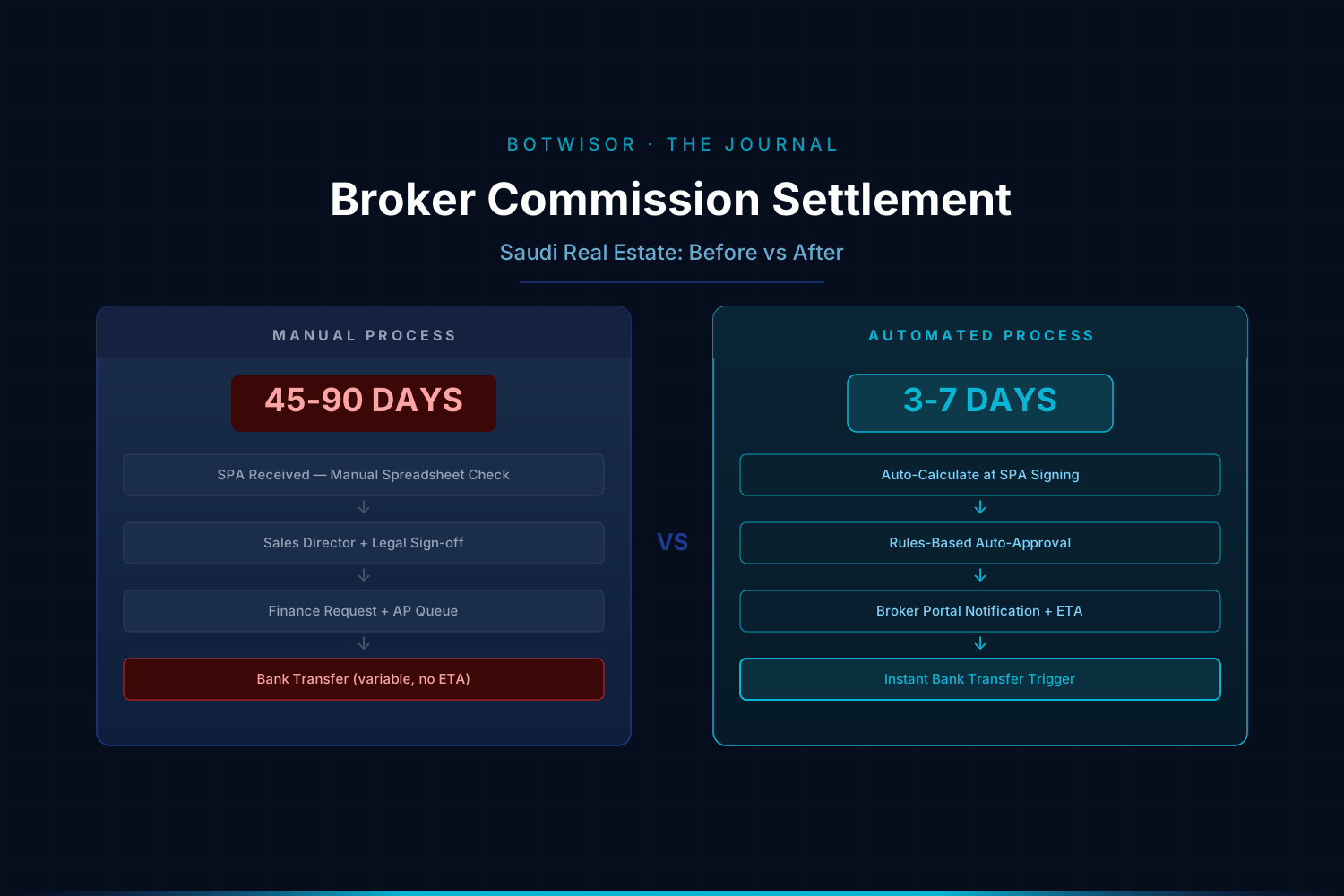
In Saudi real estate, broker firms drive a significant share of off-plan unit sales. Yet most developers settle commission payments through manual workflows that take 45 to 90 days to clear. That gap erodes broker loyalty, redirects agent capacity toward competing projects, and costs future pipeline that never appears on any internal report.
How Broker Commissions Work in Saudi Off-Plan Sales
Saudi off-plan developers typically pay broker commissions between 2% and 3.5% of the unit sale price, structured around one or two payment milestones: SPA signing and unit handover. For a SAR 1.8M unit at 2.5% commission, the obligation is SAR 45,000 per transaction to the broker firm that closed it.
For developers running multiple projects simultaneously across Riyadh, Jeddah, or the Eastern Province, the volume compounds quickly. A developer with 300 units sold in a quarter through the broker channel may carry SAR 8 to 12 million in unsettled commission liabilities at any given moment under a manual process.
The standard manual settlement sequence works like this: the sales administrator receives the signed SPA, matches unit details against a project spreadsheet, forwards the file to the sales director for verification, which then passes to finance for a payment request, which then routes to legal to confirm ownership transfer documentation, and finally lands in accounts payable for bank transfer initiation. Each handoff has its own queue and its own email thread. At a busy development company, four to six weeks can pass before anyone formally initiates the bank transfer.
What the Delay Actually Costs
The 45 to 90 day settlement cycle has a cost that registers in relationship quality, not in the ledger.
Broker firms allocate their agents' recommendation capacity toward the developer that pays predictably. When a broker agent closes a SAR 2.5M unit and then spends the next eight weeks following up on payment status by phone, that experience shapes where they steer the next qualified buyer. The agent may continue sending referrals to your project, but they weight their introductions toward developers who have demonstrated that commissions arrive without friction.
The comparison below shows how each stage of the settlement process differs between a manual workflow and an automated one.
| Commission Stage | Manual Workflow | Automated Workflow |
|---|---|---|
| Commission calculation | Spreadsheet, completed manually after SPA signing | Calculated automatically at document signing |
| Finance verification | 2 to 5 days via email chain | Real-time cross-check against project register |
| Approval routing | Multi-step sign-off, 1 to 3 weeks | Rules-based auto-approval for standard amounts |
| Broker notification | Phone call or email from sales administrator | Portal notification with payment date and transfer reference |
| Bank transfer initiation | Accounts payable queue, variable timing | Triggered automatically upon approval |
| Total settlement cycle | 45 to 90 days | 3 to 7 days |
| Commission dispute rate | High, due to manual calculation errors | Low, single source of truth across systems |
The Revenue That Doesn't Appear in Any Report
Commission delays do not create an expense line. They create what might be called invisible revenue erosion: the broker firm does not submit a formal complaint; they simply rebalance which projects they recommend when speaking to buyers.
A mid-tier broker firm in Riyadh with 12 active agents might generate SAR 40 to 60 million in annual unit sales when fully engaged with a developer. If that firm shifts its primary recommendation toward a competitor's project for two quarters, the developer will not see a corresponding debit on the income statement. They will see lower reservation numbers, which finance attributes to market conditions and which the sales director explains through pricing or location comparisons. The underlying cause, commission friction, is invisible.
This is the structure of cost-of-inaction in broker relationship management: the expense is not what you spend but what you fail to earn. It compounds across multiple broker relationships, multiple projects, and multiple quarters before anyone identifies the pattern.
How Vision 2030 Is Raising the Stakes
Saudi real estate supply is expanding faster than the broker channel is scaling to serve it. Mega-projects, new residential districts across Riyadh, and hospitality-integrated developments in NEOM and the Red Sea corridor are all competing for attention from the same pool of established broker firms and their agents.
As the supply of commissionable inventory grows faster than the supply of experienced broker relationships, developers who pay reliably and transparently gain a structural advantage. A broker firm that has experienced a 90-day settlement cycle once does not need to formally withdraw from that developer relationship. They simply fill their recommendation calendar with the three developers who have demonstrated that commissions arrive within a week.
REGA documentation requirements and VAT compliance for commission payments add an audit-trail obligation that makes manual processes more error-prone. An automated commission system produces an audit-ready record as a byproduct of its normal operation, reducing compliance overhead at the same time it accelerates settlement.
What Changes When Commission Tracking Is Automated
When commission calculation, approval routing, and payment initiation run through a connected workflow rather than a sequence of email chains, three outcomes change immediately.
First, the settlement cycle drops from weeks to days. Broker firms know, from the moment an SPA is signed, the exact commission amount, the payment milestone schedule, and the expected transfer date. That predictability removes most of the friction from the relationship.
Second, the sales team stops absorbing commission status inquiries. A broker agent's follow-up call about a commission from a unit closed two months ago takes a sales administrator 20 to 40 minutes to resolve across spreadsheets, email archives, and finance contacts. At volume, across a busy sales cycle, that indirect cost is real but never reported.
Third, finance gains a reconciled view of outstanding commission liabilities across all active projects. That view feeds accurately into cash flow forecasting, which matters significantly for developers managing staggered construction drawdowns and installment collection from buyers simultaneously. The CFO sees a number that reflects reality, not an estimate that trails reality by six weeks.
Is This the Right Priority for Your Development Business?
Not every developer needs to address this first. The broker commission backlog becomes a strategic issue when one or more of these conditions apply.
Your broker channel accounts for more than 40% of new unit reservations. Commission payment timelines have come up in conversations with broker relationship managers. You are running three or more active projects with overlapping sales cycles. You have seen unexplained softness in referral volumes from brokers who were previously reliable contributors.
If any of those conditions describe your current situation, the cost of continuing the manual process is almost certainly larger than your operational reports suggest.
A structured audit of your current commission settlement timelines, set against your referral concentration data by broker firm, usually surfaces the size of that gap within a few days of analysis. The number tends to be large enough that developers who run it once do not need convincing to act.
Ready to understand what your broker relationship friction is costing your future pipeline? Book a free automation audit and we will map your commission workflow from SPA signing to settlement in one session.