
The Journal
Saudi Corporate Clients Are Losing Tenders While Bank Guarantees Await Manual Approval
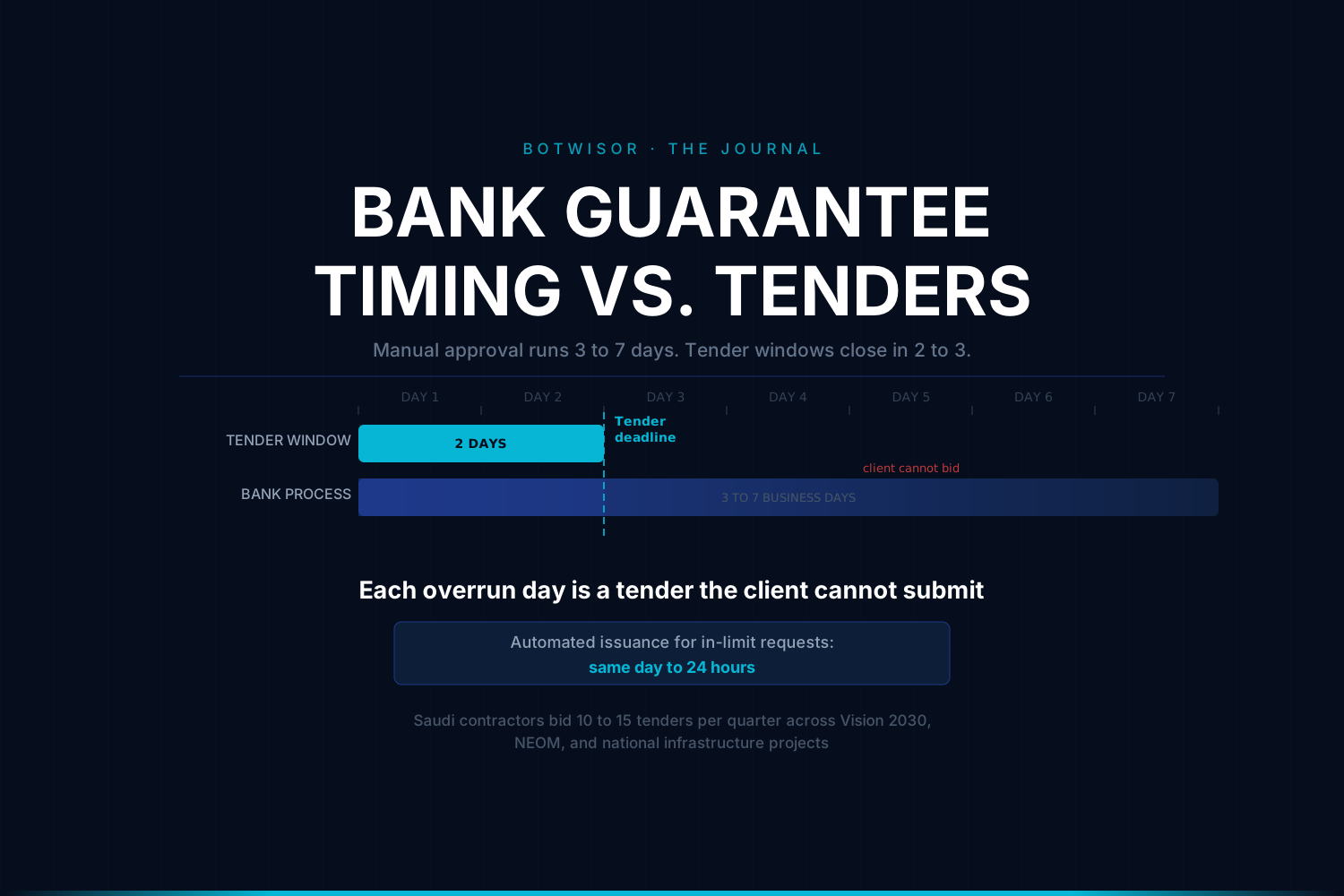
When a bank guarantee takes five days to issue and a tender closes in three, the client cannot comply. Saudi banks still process most guarantee requests through email chains and sequential manual reviews that tender authorities will not wait for.
Saudi Corporate Clients Are Losing Tenders While Bank Guarantees Await Manual Approval
Saudi corporate banks are processing bank guarantee requests through email chains and manual reviews that take three to seven business days. When the bid bond deadline for a Vision 2030 project closes in 48 hours, that timeline means the client cannot comply. The bank holds the relationship on paper. A faster competitor wins the contract.
What a Bank Guarantee Is and Why It Matters in KSA
A bank guarantee is a commitment from a bank to pay a specified amount to a named beneficiary if the bank's client fails to meet a contractual obligation. In Saudi Arabia, bank guarantees are a prerequisite for nearly every government procurement, subcontracting arrangement, and major project tender. Before a contractor can bid on an infrastructure package under the National Infrastructure Program, before a supplier can participate in a NEOM or Red Sea Project supply chain, and before a consultant can formally propose to any Vision 2030 entity, the tender authority typically requires a bid bond issued by a SAMA-regulated bank confirming the bidder's financial seriousness.
Four types dominate the Saudi corporate landscape:
- Bid bonds: confirm that the bidder will honor their submitted offer if selected
- Performance bonds: guarantee the contract will be executed according to specification
- Advance payment guarantees: cover repayment of funds disbursed to contractors before project milestones
- Retention money guarantees: substitute for physical withholding of funds during defect liability periods
Each type carries its own documentation requirements, credit committee thresholds, and compliance review steps. A Saudi contractor who bids regularly on government and mega-project work may manage dozens of active guarantees simultaneously across multiple projects and two or three banking relationships.
How the Manual Approval Process Works Today
The typical bank guarantee request at a Saudi commercial bank follows a sequence that accumulates delay at each handoff.
The corporate RM receives the request, usually by email or phone. The RM collects the basic parameters: guarantee type, amount, beneficiary, validity period, and the specific wording required by the tender authority. They then check the client's credit file manually to confirm that available headroom exists within the guarantee credit line. If the guarantee amount exceeds available headroom, the request escalates to the credit team before the issuance process begins.
Once the credit check clears, the RM assembles a guarantee application package: the client's formal request letter, Commercial Registration certificate, and the tender reference document containing the beneficiary's required guarantee wording. This package goes to the trade finance or operations team by internal email. The operations team reviews for compliance with SAMA requirements, internal credit policy, and the specific wording the tender authority specifies. Non-standard wording, which is common in government-issued tender documents, often requires back-and-forth with the RM before it can be accepted.
If any document is missing or the wording is non-compliant, the request returns to the RM. The RM contacts the client. The cycle repeats. Depending on how many rounds of review it takes to reach compliance, this exchange can occur two or three times.
Once the operations team has a complete and compliant package, guarantees above a certain size threshold require credit committee approval. The committee meets on a scheduled basis, or approvals are gathered asynchronously across committee members by email. After committee sign-off, the guarantee is drafted, reviewed by legal or compliance for exact wording, and then issued.
End to end: three to seven business days for a routine, in-facility guarantee request.
The Tender Window Problem
Saudi government procurement calendars operate on fixed submission deadlines that tender authorities do not extend. A contractor who receives a tender document on Sunday and has until Wednesday to submit faces a three-day window. A bid bond requirement embedded in those tender documents means the bank must issue the guarantee before Wednesday. At five business days for routine processing, the bank cannot meet that requirement.
The contractor has limited options: use a bank with a faster guarantee process, submit without the required guarantee and be disqualified, or decline the tender entirely. None of these outcomes appear in the bank's relationship data. There is no declined request tracked in the CRM. There is no lost mandate recorded in the deal pipeline. There is only a client who, over time, moves their guarantee business to a bank that can deliver within the tender window.
The frequency of this problem has grown with the pace of Vision 2030 procurement activity. The Ministry of Municipalities and Housing, the National Housing Company, ROSHN, and NEOM-related entities have all accelerated project tenders and subcontracting awards since 2023. Saudi contractors qualified for this pipeline are running multiple concurrent bids against compressed timelines. Each missed tender that traces back to a guarantee delay is a direct and invisible revenue impact on the client and a quiet loyalty cost for the bank.
Consider a mid-size Saudi construction company with SAR 60 million in annual project revenue, bidding on an average of fifteen tenders per quarter. If three tenders per quarter are abandoned because guarantee issuance cannot meet the submission window, and the average contract value on those bids is SAR 8 million, the company's accessible pipeline shrinks by SAR 24 million per quarter. The cost does not appear in any report the bank generates.
What the Delay Costs Both Sides
| Factor | Manual Process | Automated Workflow |
|---|---|---|
| Average issuance time | 3 to 7 business days | Same day to 24 hours for in-limit requests |
| Document re-submission cycles | 1 to 3 rounds | Near-zero with validation at intake |
| RM hours per guarantee | 2 to 4 hours | Under 30 minutes |
| Wording compliance errors | Moderate (manual drafting) | Low (template-controlled) |
| Client visibility into status | Phone and email updates | Real-time tracking |
| Tender deadline risk | High | Low |
| Relationship attrition risk | Gradual and invisible | Contained |
The cost lands on both sides. The client loses tender opportunities. The bank absorbs RM time, operations capacity, and faces relationship attrition as the client quietly routes its guarantee business elsewhere.
For the bank, the operational math is visible in aggregate. If the operations team processes SAR 1.2 billion in outstanding guarantees annually through a manual workflow requiring four hours of combined RM and operations effort per guarantee, and the average guarantee amount is SAR 1.5 million, that is approximately 800 guarantee events per year requiring 3,200 combined staff-hours. Reducing that to 800 combined staff-hours through automation represents a SAR 700,000 to SAR 1.4 million efficiency gain at current Saudi professional salary levels, before accounting for re-work on wording corrections.
The Competitive Pressure
Several Saudi banks have begun operating digital guarantee portals for established corporate clients, compressing issuance timelines to hours for pre-approved, in-facility requests with standard wording. International banks operating in KSA have offered faster guarantee turnarounds as a differentiator in corporate banking pitches.
The risk for banks that have not yet automated is not gradual erosion. Corporate clients who experience a faster guarantee process at a competitor tend to move their guarantee line, and guarantee relationships anchor broader corporate banking relationships. The bank that issues the guarantees sees the client's project calendar, their payment flows, and their next financing need. A client that moves their guarantee business to a faster bank is a client whose next corporate finance mandate is already at risk.
What Automation Changes
Banks that have redesigned the guarantee workflow around structured automation have reduced end-to-end issuance time by addressing several layers at once. Digital intake forms validate completeness at submission, eliminating the first round of re-work cycles. Pre-approved guarantee templates remove the wording review step for standard guarantee types, covering the majority of bid bond and performance bond requests. Credit exposure checks run against live facility data rather than manually pulled credit files. For in-limit requests, digital approval routing replaces email chains with time-stamped confirmations. The client tracks status through a portal rather than through the RM's availability.
None of this removes the RM from the relationship. The RM who previously spent four hours per guarantee now spends under thirty minutes on routine requests. The time saved goes back to the relationship conversations that generate the next mandate, not to chasing approvals through internal email.
The compliance improvement is equally important. Every guarantee issued through an automated workflow carries a complete, retrievable audit trail: the client request, the credit check result, the approval record, the final wording, and the issuance confirmation. When SAMA or internal audit requests documentation on a specific guarantee, retrieval takes minutes rather than a reconstruction from email threads.
The Next Tender Is Already Open
Saudi contractors are reviewing tender documents today. Some of those documents include a guarantee requirement with a submission deadline shorter than the current guarantee issuance timeline at their incumbent bank. The contractors who know which bank can deliver within the window will place the request now. The contractors who do not know will discover the timeline problem on day three and have to decide whether to escalate or withdraw.
The banks that have closed the guarantee processing gap are capturing those mandates. The banks that have not are losing them without a visible transaction in the data to mark the loss.
If your guarantee issuance timeline is costing your corporate clients their tender windows, the gap between where you are and what structured automation delivers is worth understanding before your next relationship review. BotWisor offers a free automation audit for Saudi financial institutions: we map your current guarantee workflow, identify where the delay accumulates, and show what a practical automation path looks like before you commit to anything.