
The Journal
The AML Review Backlog Saudi Banks Treat as a Fixed Cost
Saudi banks absorb a growing compliance workload by staffing up the review queue. The queue still grows. The real cost is in what that model prevents.
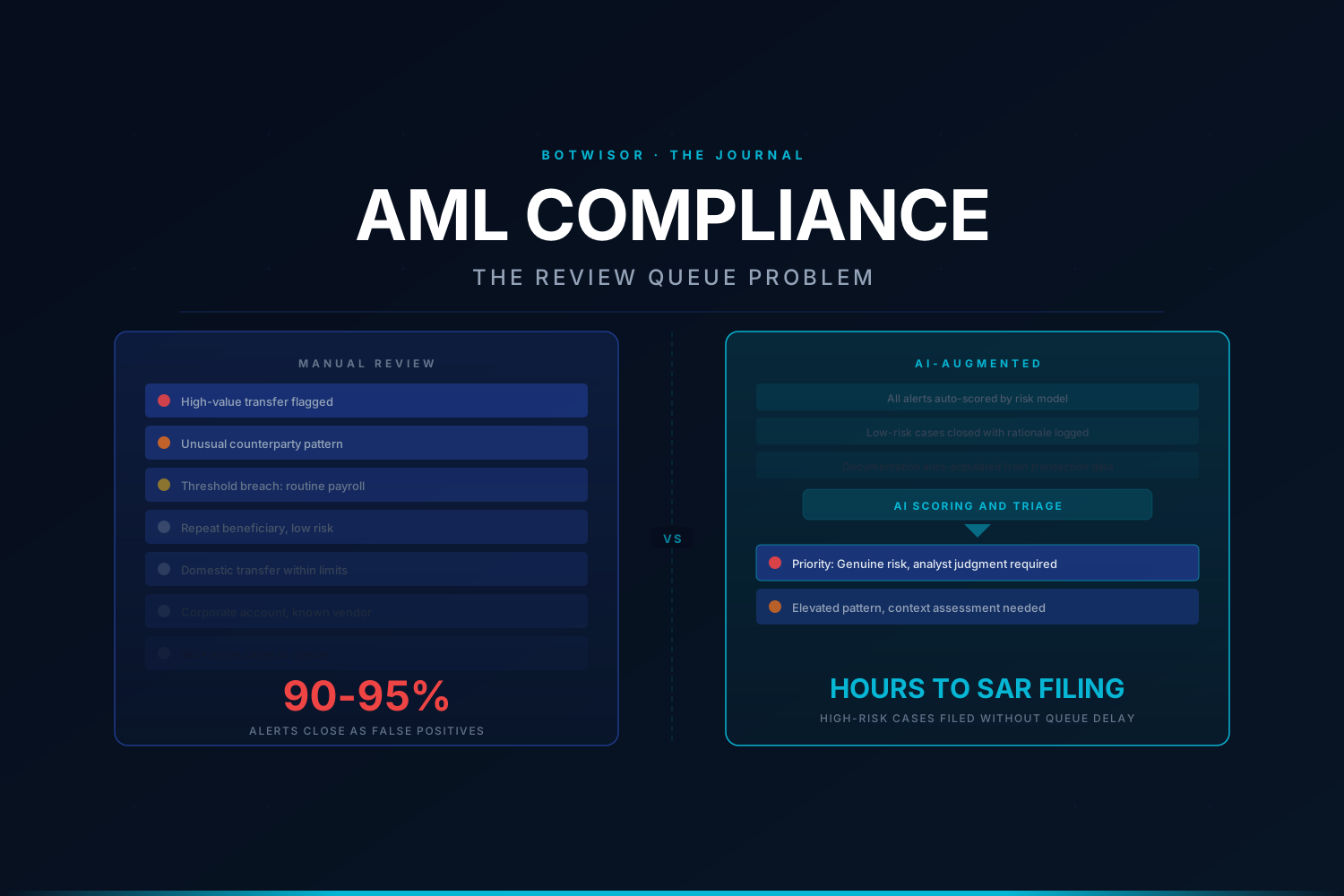
Saudi banks running AML compliance through manual alert review carry a cost that most compliance heads can describe but rarely calculate: analysts spending the majority of their working hours confirming that flagged transactions are legitimate, while genuine cases wait at the back of the queue. As Vision 2030 drives transaction volumes higher, the queue grows accordingly.
What a Manual AML Operation Looks Like Day to Day
Each morning in a Saudi bank's compliance function, the transaction monitoring system delivers an overnight alert batch. Depending on the bank's size, its threshold configuration, and the prior day's transaction volume, that queue might hold several dozen to several hundred cases.
Working through the queue means opening each alert, reviewing the underlying transaction and account history, cross-referencing the customer against watchlists and counterparty profiles, assessing whether a business rationale exists, writing a disposition narrative, and recording the outcome in the case management system. Where the evidence warrants escalation, a senior analyst adds a second review layer before the case either closes or proceeds to Suspicious Activity Report preparation.
The process is conservative by design, and rightly so. The problem is not that it exists. It is that the majority of cases in the queue, on any given day, were almost certainly going to be closed as false positives before the analyst opened them. The judgment required to reach that conclusion is minimal. The documentation required to record it is not.
The Backlog That Becomes Normal
Transaction monitoring systems at most banks operate on rule-based thresholds calibrated to detect a wide range of behavioral patterns. Industry research consistently finds that between 90 and 95 percent of alerts generated by traditional, rules-based systems do not result in a Suspicious Activity Report. The analyst's primary daily task is, in statistical terms, confirming that transactions are legitimate.
When alert volumes grow faster than analyst capacity, compliance functions manage the gap in one of three ways. Some add headcount, absorbing the cost into an expanding compliance budget treated as necessary overhead. Some extend case clearance windows, allowing a formal or informal backlog to accumulate while older cases wait. Some adjust thresholds to reduce alert volume, which shrinks the queue but creates its own risk: threshold changes that cannot be justified against SAMA's AML/CFT expectations can become examination findings in their own right.
None of these responses changes the underlying structure. They are each, in their own way, a decision to keep managing the same problem with more resources or more tolerance for delay.
Where the Cost Accumulates
Skilled hours on low-judgment work. A senior AML compliance analyst in Riyadh or Jeddah earns between SAR 20,000 and SAR 30,000 per month. At a 90 percent false positive rate, nine-tenths of that analyst's productive hours confirm what was already likely before the review began. The cases requiring genuine judgment, including typology assessment, pattern recognition, and SAR drafting, receive whatever time remains.
SAR filing delays. SAMA's AML/CFT supervisory framework sets clear expectations for the timeliness of Suspicious Activity Report filings once suspicious activity is identified. When a compliance team operates under a persistent backlog, the path from detection to filing lengthens. Cases meeting the threshold for escalation sit behind routine queue items, compressing the filing window. Delayed filings are among the findings most consistently cited in SAMA examinations of compliance functions.
Documentation inconsistency. Manual case review produces documentation that varies by analyst, by workload, and by how much time remains in the day. SAMA examiners reviewing case files look for consistency of rationale, depth of analysis, and completeness of documentation. A team under queue pressure produces records that are thinner on busy days and more thorough when the queue is light. That variability becomes visible in examination.
Typology development foregone. Building institutional knowledge of the patterns specific to Saudi financial flows, including structured real estate payments, cross-border correspondent flows tied to Vision 2030 project finance, and SME transaction structures that may indicate layering, requires time and senior analytical attention. Banks whose senior analysts spend most of their day on queue triage develop that knowledge slowly, if at all.
Before and After: Two AML Operations Models
| Dimension | Manual AML Review | AI-Augmented AML Review |
|---|---|---|
| Alert prioritization | Queue order or transaction size | Risk-scored queue; highest-priority cases surface first |
| Analyst time on false positives | 90–95% of daily hours | Substantially reduced; AI handles first-pass triage |
| Case documentation | Manual narrative per case | Transaction data auto-populated; analyst adds judgment |
| Time from detection to SAR filing | Days to weeks depending on backlog depth | Hours to days for high-scoring cases |
| Senior escalation trigger | Analyst judgment on each case | Anomalous pattern flags surface automatically |
| Audit trail consistency | Varies by analyst and workload | Uniform, timestamped, searchable across all cases |
| Examination preparation | Manual narrative synthesis and case selection | Exportable record with AI scoring rationale attached |
The move from the left column to the right does not require replacing the core banking system or the transaction monitoring platform. It requires adding a scoring and prioritization layer between the alert engine and the analyst queue, and connecting that layer to the case management system where documentation is recorded.
What Changes When the Queue Clears
When AI triage handles first-pass scoring and reprioritizes the queue by risk rather than arrival time, the compliance function changes in its daily character. Analysts still review cases; they review them in an order where the genuinely suspicious appear first, not the most recently flagged.
Senior compliance professionals recover time to work on what manual queue operations displace: developing Saudi-specific typology libraries, engaging with SAMA on emerging risks, and calibrating threshold parameters based on patterns the bank is actually observing. Each of these activities improves detection quality over time. Clearing false positives does not.
SAMA examinations change character as well. A bank presenting a consistent, well-documented case record, where high-risk cases demonstrably received faster attention and more thorough documentation, occupies a different position than one presenting variable-depth case files assembled under queue pressure.
The Scaling Problem Vision 2030 Creates
Saudi bank transaction volumes are growing because of structural economic change, not temporary cyclical variation. NEOM, Red Sea Project, and the broader giga-project supply chain are generating new corporate banking relationships, new cross-border correspondent flows, and new payment patterns that transaction monitoring systems will flag heavily in the early stages of each new account relationship.
SME banking expansion, inbound foreign direct investment, and the formalization of previously cash-heavy sectors add further volume to every bank's monitoring workload. Vision 2030's broader financial-sector deepening, including Saudi Exchange growth, new financial products under SAMA frameworks, and the expansion of digital banking, translates directly into more transactions per day that rules-based systems must assess.
Rules-based transaction monitoring scales with transaction volume. Analyst headcount cannot scale at the same rate without proportional cost increases that compress compliance margins. Banks managing this gap through annual hiring rounds are running ahead of a structural deficit that widens each year.
The AML operations model sustainable at SAR 10 billion in deposits is not the same model that holds at SAR 30 billion. Addressing the review workflow before volume growth forces the issue is a different conversation than rebuilding a compliance function under active examination pressure.
If your compliance team spends most of its day on queue clearance rather than judgment, the cost is larger than the headcount line suggests. → Book a free automation audit. The conversation takes 45 minutes and produces a specific operational assessment of where AI triage would move the needle for your AML function.