
The Journal
The Admin Load Keeping Saudi Bank RMs Away from Clients
Saudi bank RMs spend less than a third of their day in client conversations. The rest goes to administrative work that automation can handle. Here is what that misallocation costs.
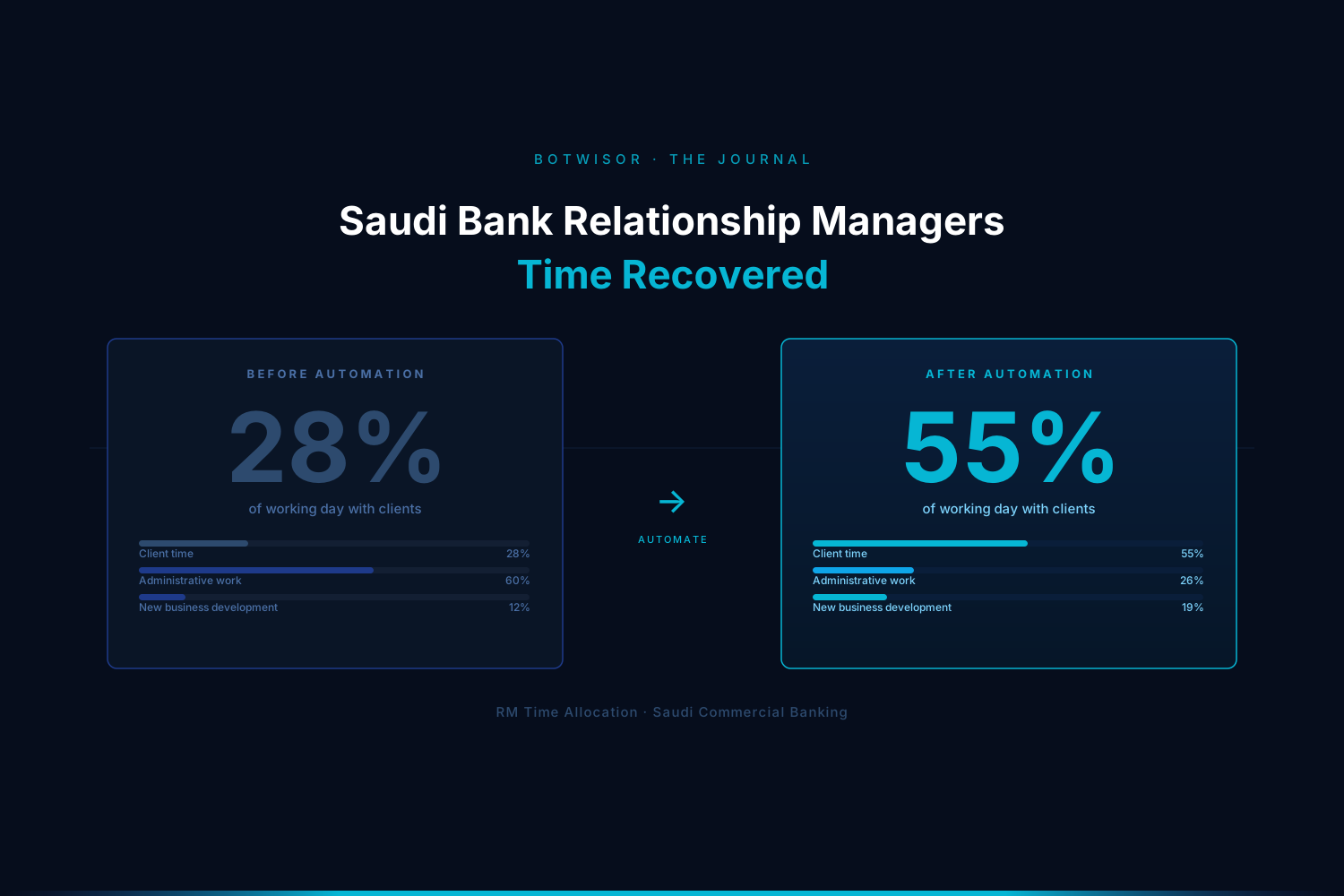
Saudi bank relationship managers are, on paper, the growth engine of corporate and retail banking: they own client relationships, drive cross-sell, and convert pipeline to revenue. Industry benchmarks consistently show, however, that most spend less than a third of their working day in actual client conversations. The remaining two-thirds goes to administrative tasks that do not require their level of expertise, and the commercial cost of that imbalance is measurable.
What Does a Saudi Bank RM Actually Do All Day?
The frustration is familiar to most banking heads. Ask what an RM's day looks like and the list invariably includes activities that have little to do with advising clients.
A typical day for a corporate RM at a Saudi commercial bank follows a recognizable pattern:
- Reviewing overnight transaction alerts and routing queries to compliance
- Pulling pre-meeting account history from multiple disconnected systems
- Taking manual call notes for later entry into the CRM
- Writing post-call summaries and updating opportunity records
- Compiling pipeline reports from CRM exports and spreadsheets
- Preparing internal credit memos and exception documentation
The actual time available for advisory work, whether structuring a financing proposal, reviewing a client's treasury position, or responding to a refinancing request, is often fewer than two hours in an eight-hour day.
Research from major banking consultancies consistently places client-facing time for corporate and retail RMs at between 25% and 35% of the working day. The Saudi context adds pressures that compound this number. Shariah-compliant product structures carry documentation requirements that conventional products do not. SAMA's internal reporting cadence generates compliance work at the branch level. And many Saudi commercial banks operate across legacy core banking systems that were never designed to share data, which means RMs assemble information manually for tasks that could be automated.
The Revenue Cost of Misallocated RM Time
An RM managing a SAR 120M corporate portfolio typically carries 30 to 45 active relationships. If meaningful client contact is limited to two hours per day, each client receives roughly 15 minutes of quality interaction per working week across a book with complex, time-sensitive needs.
The consequences compound over time.
Cross-sell opportunities require context: an RM who has not reviewed a client's recent cash flow pattern cannot identify the right moment to propose a working capital facility or a structured deposit. Retention erodes when clients rarely hear from their banker. New business development stalls when the RM has no capacity left beyond managing the existing book.
| Activity | Before Automation | After Automation |
|---|---|---|
| Client meetings, calls, and advisory work | 25 to 30% of day | 50 to 60% of day |
| CRM data entry and interaction logging | 20 to 25% of day | 3 to 5% of day |
| Pre-meeting research and report assembly | 15 to 20% of day | 5 to 8% of day |
| Transaction alert triage and query handling | 10 to 15% of day | 2 to 4% of day |
| Pipeline and compliance reporting | 15 to 20% of day | 6 to 10% of day |
| Other administrative tasks | 10% of day | 18 to 20% of day |
These figures reflect directional outcomes from banks implementing RM automation across GCC markets; specific results depend on product mix, existing systems, and integration depth. The consistent pattern is that client-facing time roughly doubles when administrative tasks are systematically automated.
Where Administrative Hours Actually Go
Three categories account for the bulk of RM administrative time, and all three share the same characteristic: they are largely procedural rather than judgment-intensive.
CRM data entry is the clearest example. Most Saudi bank RMs are required to log every material client interaction: call notes, meeting summaries, opportunity stage updates, and action items. When this happens manually, after the fact, from memory, two things follow. The quality of records degrades because recall is imperfect. And the time cost is real. An RM with 12 client interactions in a week can spend three to four hours writing up notes that a system capable of transcribing calls automatically could generate in real time.
Pre-meeting research is the second major drain. Preparing properly for a corporate review meeting requires account history, recent transaction patterns, credit utilization, upcoming maturities, and any open service requests or compliance flags. When these sit across a core banking system, a risk platform, a document management tool, and a spreadsheet tracker maintained by a separate team, assembling a useful briefing takes 30 to 45 minutes per meeting. An RM with four meetings in a working day loses two hours to preparation alone.
Internal reporting compounds both. Pipeline reports, portfolio exception summaries, and credit memo preparation all require data from systems that do not communicate with each other. Stitching these together manually is time-consuming, produces no client value, and introduces transcription errors that occasionally require correction cycles of their own.
What Changes When Automation Handles the Administrative Layer
The purpose of RM automation is not to replace relationship managers with software. It is to restore their time to the work that genuinely requires their expertise.
Automated call logging. Voice AI can transcribe client calls and meetings, extract key discussion points and action items, and push structured entries into the CRM while the RM is still in the conversation. The record is more accurate than a manually reconstructed summary and requires no additional time from the RM.
Pre-meeting briefing packs. A system integrated with the core banking platform and document management tools can generate a structured client briefing automatically before each scheduled meeting: recent transaction activity, current credit position, upcoming maturities, and any open service requests. The RM arrives prepared without spending the morning pulling information manually.
Alert triage. Transaction monitoring generates significant alert volume. Most alerts follow patterns that can be resolved by rule or routed to the appropriate team without RM involvement. Surfacing only genuine exceptions to the RM reduces daily interruption and frees attention for client interactions.
Automated reporting. Weekly pipeline and portfolio reports can be generated directly from CRM and core banking data on a scheduled basis. The head of banking receives consistent, complete information; the RM recovers the hours previously spent assembling it by hand.
None of these changes affect how the RM interacts with clients. They remove the layer of administrative work that surrounds those interactions.
The Vision 2030 Dimension
SAMA's Financial Sector Development Program sets explicit targets for the banking sector: expanded credit access, growing SME lending, higher customer satisfaction across retail and corporate banking. Meeting those targets while competing against increasingly capable fintech entrants and regional banks requires Saudi institutions to be more productive with their existing workforce.
Saudi Arabia's banking sector is growing. Private sector credit expanded through 2024 and 2025 as Vision 2030-linked infrastructure and industrial diversification projects generated financing demand. Corporate banking portfolios are larger than they were three years ago, which means more relationships for the same RM headcount to manage.
Banks automating the RM administrative layer now are building capacity to absorb that growth without proportional headcount additions. Banks that are not will face a choice between aggressive hiring or declining service quality per client, a poor trade-off at a moment when competitive intensity in Saudi banking is increasing.
Assessing the Gap in Your Operations
The diagnostic does not require a technology audit. It requires an honest answer to two questions.
First: what percentage of an RM's day is currently client-facing? If the genuine answer from the heads of your corporate and retail banking divisions is below 35%, the administrative load is above the threshold at which it visibly affects revenue.
Second: of the administrative work filling the remaining time, how much requires RM-level judgment, and how much is procedural execution of a predictable workflow? In most Saudi banks, the answer identifies three to five workflow categories that are directly automatable within the existing technology footprint.
The business case follows directly from those two answers. The mapping itself, which workflows, which systems, and what the client-facing time recovery looks like in practice, is the starting point for any serious conversation about RM productivity.
→ Book a free automation audit to map the administrative load in your RM operations and quantify the client-facing time currently going to paperwork.