
The Journal
The Abandoned Cart Revenue Saudi E-Commerce Brands Accept as Normal
Between 65% and 75% of Saudi online shopping sessions end with a full cart and no purchase. Most brands absorb this as fixed cost. A meaningful share of that revenue is recoverable, and the gap compounds as GMV scales.
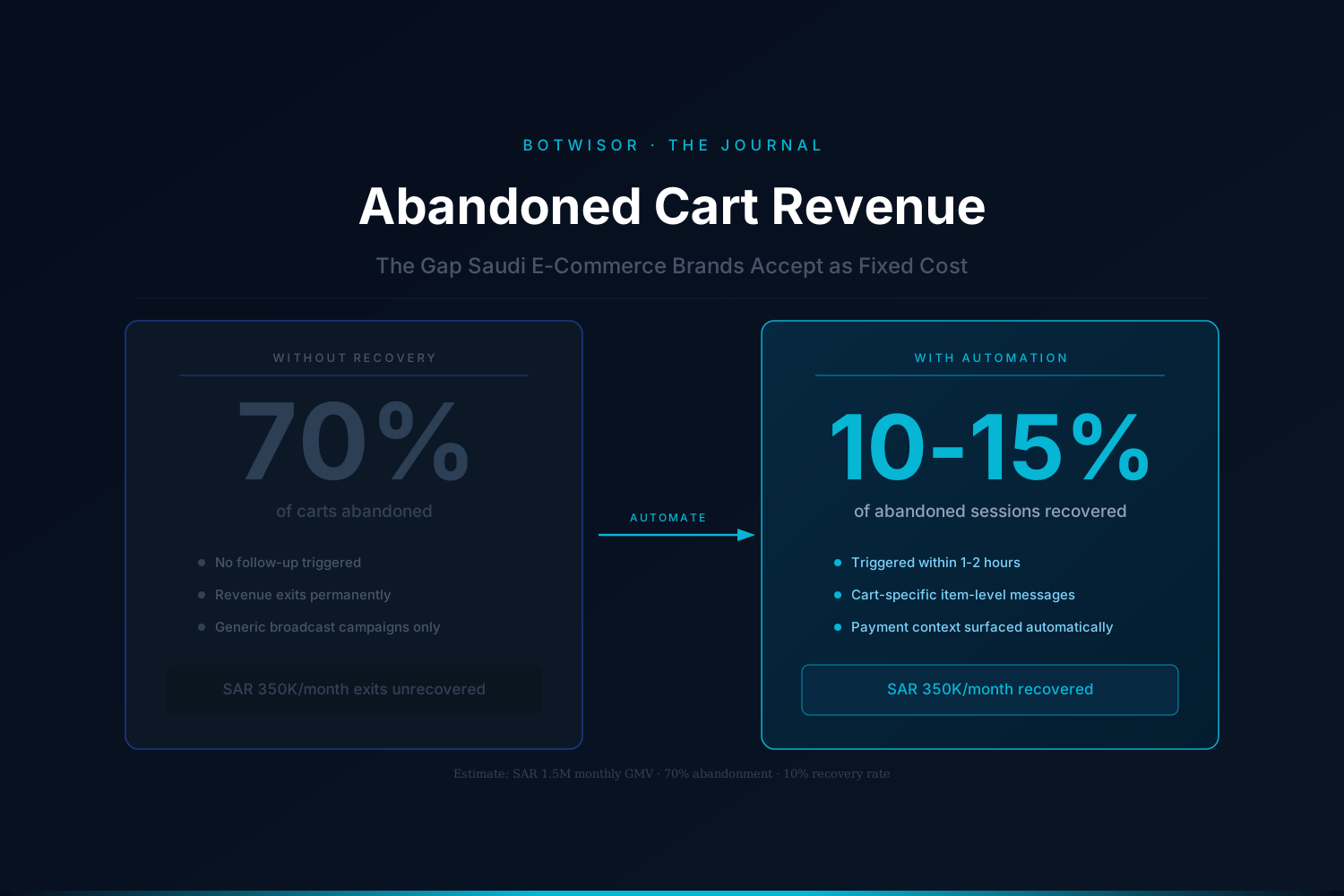
Between 65% and 75% of Saudi online shopping sessions end with a full cart and no purchase. Most operators track this figure, note it with some frustration, and absorb it as a fixed cost of doing business online. A meaningful share of that revenue is recoverable, and the gap between brands that act on it and those that do not grows with every passing month.
Why Does Cart Abandonment Run Higher in Saudi E-Commerce?
The global average cart abandonment rate sits around 70%. Research covering MENA e-commerce markets consistently places the regional figure above that baseline, and several factors specific to Saudi Arabia explain the excess.
Cash on delivery remains a meaningful payment preference for a segment of Saudi online shoppers. When those shoppers reach checkout and find only card-based or digital wallet options, they stop. Delivery cost expectations have risen sharply in step with the expansion of same-day and next-day logistics services across Riyadh, Jeddah, and Dammam. Brands that surface shipping fees only at the final checkout step, rather than on the product page, create a friction point at precisely the moment when purchase intent is highest.
Saudi smartphone penetration is among the highest globally, and a significant share of browsing and product discovery happens on mobile. Checkout flows on mobile devices are more susceptible to interruption: a notification, a call, or a minor friction in the payment form converts a near-purchase into an abandonment event. The analytics platform registers it; most systems do not automatically act on it.
The underlying pattern is not unique to Saudi Arabia. What is specific to the KSA context is the gap between how common abandonment is and how limited most brands' recovery infrastructure remains.
What Are Saudi E-Commerce Brands Actually Losing?
The calculation starts with a straightforward relationship. At a 70% cart abandonment rate, completed purchases represent roughly 30% of total shopping intent. For every SAR 1 in realized GMV, approximately SAR 2.33 in intent is sitting in carts that were abandoned.
Consider a brand generating SAR 1.5 million in monthly online gross merchandise value. Total shopping intent across all sessions runs approximately SAR 5 million. SAR 1.5 million of that converts to purchases; roughly SAR 3.5 million sits in abandoned carts each month.
Not all of that SAR 3.5 million is recoverable. Some shoppers are browsing without immediate purchase intent. Others return organically within a day or two. But research across comparable e-commerce markets consistently shows that 8% to 15% of abandoned sessions that receive a timely, relevant re-engagement message convert.
Applied to this example: at a 10% recovery rate, the brand captures an additional SAR 350,000 per month in revenue that was already in the pipeline. That figure does not require additional ad spend, new customer acquisition, or expanded inventory. It is revenue the brand already paid for through traffic.
For brands with monthly GMV in the SAR 500K to SAR 3M range, this delta across twelve months represents a meaningful shift in revenue on a base that is already funding the traffic. The cost is not the recovered revenue; it is the absence of a process to capture it.
Manual vs. Automated Recovery: What the Gap Looks Like
| Dimension | Without Recovery Automation | With Recovery Automation |
|---|---|---|
| Trigger timing | None; or delayed batch campaign | Within 1–2 hours of abandonment |
| Message content | Generic promotion to full subscriber list | Cart-specific, item-level reference |
| Payment context awareness | Not addressed | Surfaced based on checkout signals |
| Session coverage | Partial; manual segmentation required | All qualifying registered sessions |
| Estimated recovery rate | Under 2% direct attribution | 8–15% of abandoned sessions |
| Ops overhead per cycle | Moderate; campaign build required | Low after initial configuration |
The difference between the left and right columns is not a platform migration or a large technology project. It is a configured automation layer that reads existing checkout event data, existing customer records, and existing communication channels. The setup effort is bounded; the ongoing overhead is substantially lower than managing a campaign-based recovery model.
Why Do Saudi Retail Teams Leave This Gap Open?
Three patterns consistently explain why Saudi e-commerce operators have not addressed cart abandonment recovery, even when the cost is visible in their analytics.
The broadcast mindset. Teams that built their email and SMS channels around campaign cadences find it structurally difficult to shift to event-triggered logic. Their templates, approval cycles, and performance metrics are built for scheduled sends. The concept of a trigger that fires automatically for an individual session, at a variable time, sits outside that mental model and outside the workflow currently governing the channel.
Invisible attribution. Most Saudi e-commerce analytics tools surface cart abandonment rate as a metric but do not automatically segment recoverable sessions or report recovery revenue as a separate attribution line. Without that visibility, the gap registers as a market condition rather than as an operational gap with a traceable cost. What teams cannot measure, they tend not to prioritize.
Misestimated scope. Cart recovery automation is frequently associated with platform migrations because teams anchor on the most complex version of the problem they have heard about. In practice, recovery automation sits above existing infrastructure, reads existing data, and uses existing channels. The implementation scope is bounded. The misconception about scope is a more common driver of inaction than budget constraint.
What Does Automated Recovery Change About the Operation?
The post-automation state looks different in two ways.
On the revenue side: sessions that would have exited permanently now enter a structured follow-up sequence calibrated to what was left in the cart, when the abandonment occurred, and what signals the checkout captured. Recovery rates are not dramatic in absolute volume terms; they are consistent, attributable, and generated from traffic the brand already paid for.
On the operations side: the marketing team no longer decides whether to build a recovery campaign, which segment to include, or when to send. The trigger-based system operates on its own logic. The team focuses on brand campaigns, category launches, and promotional programs that require human judgment and creative input.
A brand running recovery on automation and brand work on campaigns has separated two fundamentally different types of marketing activity: one that benefits from consistency and trigger precision, one that requires creative direction and timing judgment. Mixing both on the same campaign infrastructure costs performance on both.
What Does This Mean for Saudi E-Commerce at Scale?
Saudi e-commerce has grown at double-digit rates over the past several years, supported by Vision 2030's investments in digital logistics infrastructure, domestic payment rails, and consumer-facing platforms. As more Saudi household spend moves online, GMV for established brands is trending upward.
The compounding implication is direct: as GMV grows, the cost of unaddressed cart abandonment grows with it. A brand absorbing SAR 350,000 monthly in unrecovered cart value at SAR 1.5M GMV absorbs SAR 700,000 at SAR 3M GMV under the same operational conditions. The gap is not resolved by growing the business; it expands alongside it.
Addressing recovery while the configuration work is straightforward is more efficient than addressing it after scale has made the problem larger and the organization more complex. The brands that build this function now will carry the advantage into higher-GMV periods, compounding the difference with each passing quarter.
The revenue above is not in a future capability. It is already in the pipeline, leaving through a gap that a systematic recovery process would close. If the figures in this article approximate your operation, the first step is understanding exactly where sessions are dropping and what infrastructure currently exists to act on them.
Book a free automation audit to map your specific abandonment gap.